Someone comes to you with a BaZi chart and asks a very specific question. Should I change jobs? Is this a good time to start a business? Will this relationship work out?
Can a BaZi chart answer questions like these directly, or are we asking the chart to do something it was not originally designed to do?
This is where an important distinction needs to be made. Natal BaZi analysis, timing analysis and question-based divination may all sit within the wider world of Chinese metaphysics, but they are not necessarily the same analytical process.
Understanding that difference helps us use BaZi more carefully and prevents school-specific divination techniques from being presented as universal BaZi rules.
What Does BaZi Primarily Analyse?
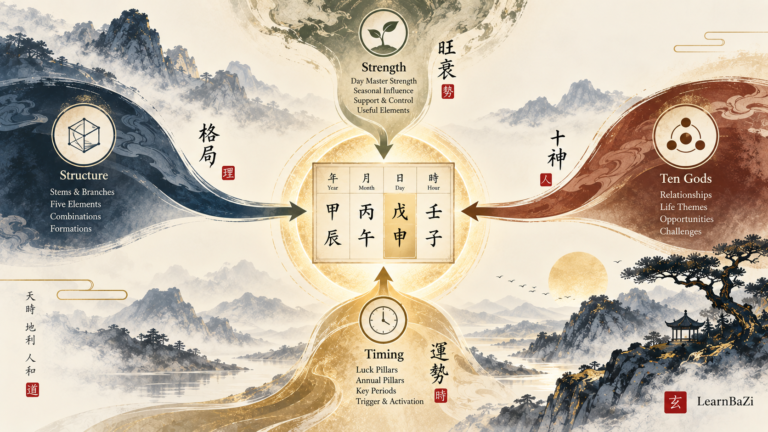
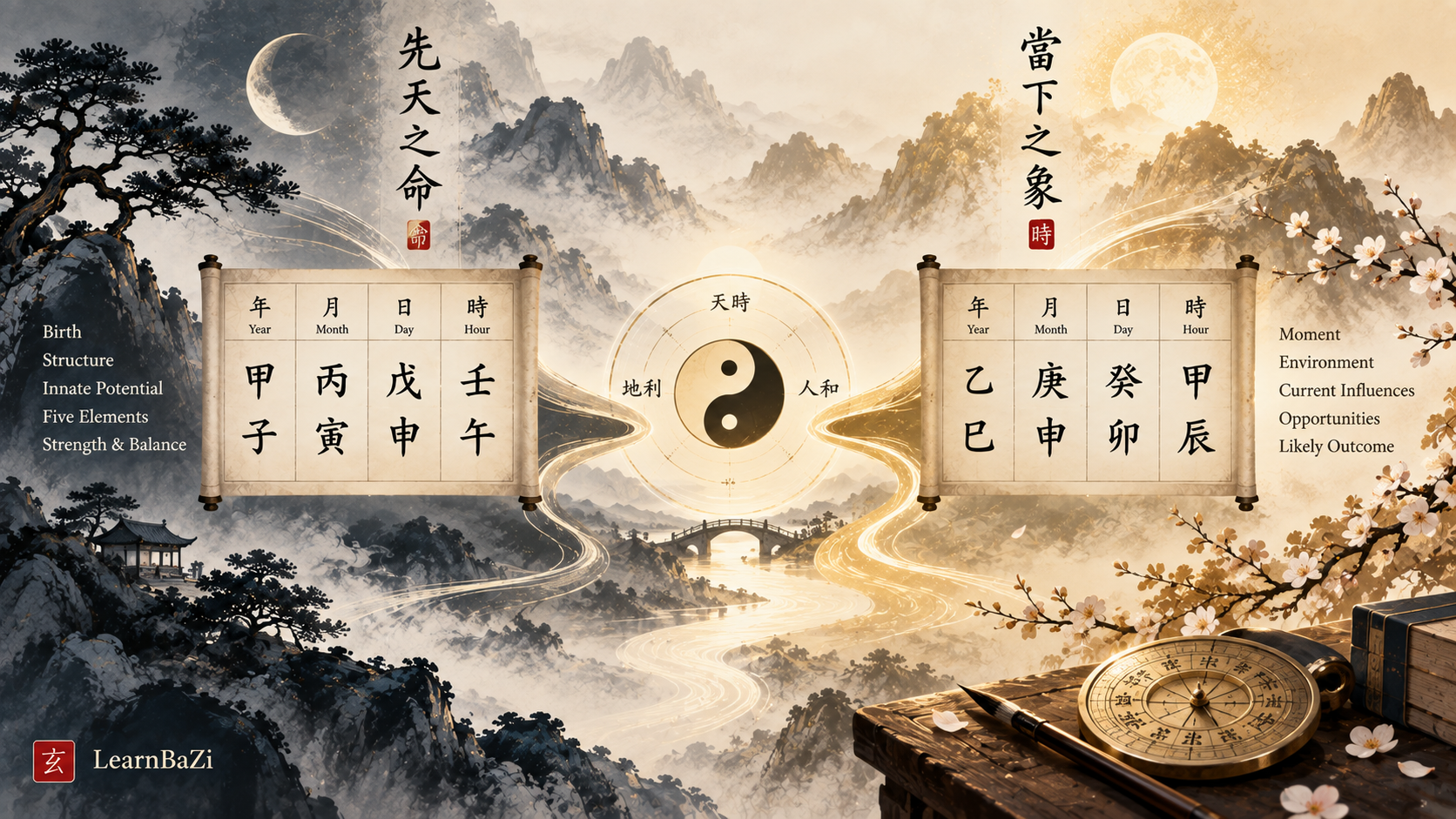
A BaZi natal chart is constructed from a person’s Year, Month, Day and Hour of birth. These Four Pillars form the underlying chart that practitioners study throughout the person’s life.
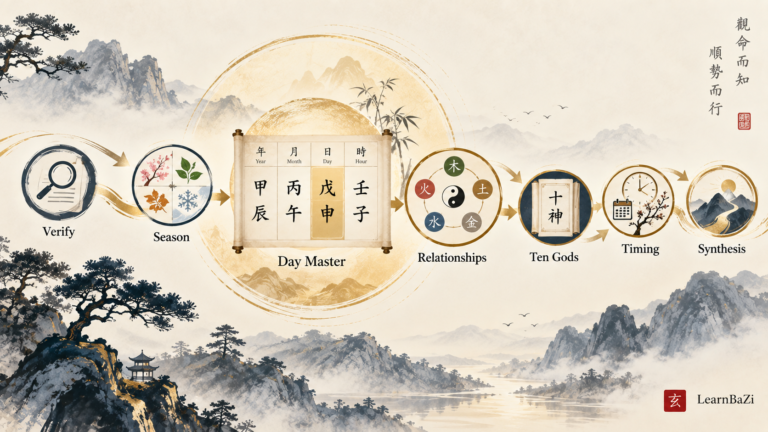
From there, we may examine the Day Master, Five Elements, Ten Gods, Heavenly Stems, Earthly Branches, roots and other relationships within the chart.
Luck Pillars, annual pillars and other timing influences can then be introduced to study how changing conditions interact with the natal chart.
The important point is that the natal chart remains the reference point.
What Is Question-Based Divination?
Question-based divination starts from a different place. Instead of focusing primarily on a person’s natal structure, the method is organised around a specific question, situation or moment.
Different Chinese metaphysical systems have developed their own ways of doing this. The I Ching is one familiar example, while other systems may use the configuration of a particular time or situation.
These systems may share concepts such as the Five Elements, Heavenly Stems or Earthly Branches with BaZi, but that does not automatically make them the same method.
Each system has its own framework and should be understood on its own terms.
Can BaZi Still Help Answer a Specific Question?
Yes. A BaZi chart can provide useful information when the question relates to themes already represented within the natal chart and its timing.
Suppose someone asks whether the coming year looks supportive for a career change. We can examine the natal chart, current Luck Pillar and annual influence to see which relationships are becoming more prominent.
Perhaps the chart shows stronger themes connected with responsibility, movement, expression or commercial activity. Those observations may help us understand the conditions surrounding the decision.
That is different from treating the chart as a simple yes-or-no oracle.
The Question Gives the Reading Focus
A specific question is still useful because it tells us where to focus our attention. A career question and a relationship question do not require exactly the same emphasis.
If the question concerns career, certain Ten God relationships, pillars and timing influences may deserve closer examination. A relationship question may direct our attention elsewhere.
The natal chart has not changed. The analytical focus has.
This is one reason a good BaZi reading should begin with a clear understanding of what the person actually wants to know.
For Example: Should I Change Jobs?
Imagine someone asks whether this is a good year to leave a stable job for a new opportunity. A careful BaZi analysis would not search for one symbol that simply means “change jobs.”
Instead, we would look at the relevant natal relationships and examine how the current timing is interacting with them.
The chart may suggest stronger themes of movement, responsibility, expression or opportunity. That can be useful information, but it still needs to be considered alongside the person’s actual circumstances.
Is there a real offer? Is the new role financially sustainable? What are the risks of leaving?
BaZi can add context to the decision. It should not replace the decision-making process.
BaZi Timing Is Not the Same as Divination
This distinction is important. When we analyse a Luck Pillar or annual pillar, we are still studying how changing time interacts with the natal chart.
The natal chart remains the foundation, while the incoming pillar modifies the conditions around it.
Question-based divination may work differently because the chart or configuration can be constructed specifically around the question or moment itself.
Both approaches can be useful, but they should not be treated as interchangeable simply because they use similar metaphysical language.
What About Using the Chart of the Current Moment?
Some practitioners use the Heavenly Stems and Earthly Branches of the current time or moment as part of a question-based reading. Certain schools may also apply BaZi-like relationships to a chart constructed when the question is asked.
These methods can be meaningful within the system being taught. But they should be identified clearly as a specific divination method rather than presented as the standard way all BaZi practitioners work.
If a method uses the moment of the question, it should also explain why that moment matters and how the resulting chart is interpreted.
The framework matters just as much as the symbols being used.
Can Any BaZi Chart Answer Any Question?
I would be cautious with this idea. If almost any chart can be used to answer any question, we need a clear explanation of why that chart represents the situation being examined.
Without a defined framework, it becomes difficult to separate genuine analysis from interpretation built around whatever happens to be visible in the chart.
This does not mean intuitive or school-specific methods have no value. It means they should be presented honestly as particular methods rather than universal BaZi principles.
Clear boundaries make the system easier to understand and teach.
BaZi Is Better at Conditions Than Guarantees
When BaZi is used for a specific question, it is often more useful to think in terms of conditions rather than certainty.
A period may look more supportive for change, more demanding in terms of responsibility or more active in a particular area of life.
That gives the person something useful to consider.
It does not mean that one exact event must happen simply because a particular relationship appears in the chart.
When Is BaZi Most Useful for a Question?
BaZi is especially useful when the question relates to broader patterns and changing conditions over time. Career direction, relationship themes, business decisions and major life transitions can all be examined within this context.
It can also help us understand why one period feels different from another and which themes may deserve greater attention.
Where BaZi becomes less suitable is when we expect the natal chart to behave like a yes-or-no oracle for every immediate decision.
Some questions may be better suited to a system specifically designed for question-based divination.
Do Not Force Every Question into BaZi
A good practitioner does not need to prove that BaZi can answer everything. Different metaphysical systems were developed for different purposes.
If the natal chart and timing provide useful evidence, use them. If the question falls outside what the method can reasonably support, it is better to acknowledge that limitation.
This does not weaken BaZi.
Clear limits often make a method more credible because we are using it where its analytical framework is strongest.
A Practical Way to Approach Specific Questions
When someone brings a specific question to a BaZi reading, I prefer to keep the analysis grounded in the natal chart rather than immediately turning it into a form of divination.
Clarify the question first. Then examine the relevant natal relationships and see how the current timing interacts with them.
Look for several observations pointing in a similar direction rather than relying on one dramatic feature.
Finally, bring the person’s real circumstances back into the discussion. BaZi can help describe the conditions, but the practical decision still belongs to the person.
So, Can BaZi Answer a Specific Question?
BaZi can certainly help analyse a specific question when that question is considered in relation to the person’s natal chart and changing timing influences.
It can highlight themes that are becoming more active and help us understand whether a period appears more supportive, demanding or uncertain.
What it should not become is a claim that any chart can automatically provide a certain answer to any question.
If a practitioner uses a separate divination method based on BaZi-style symbols, that method should be recognised and taught as its own framework.
For LearnBaZi, the priority remains clear: understand the natal chart, examine the relevant timing and distinguish carefully between what the chart shows and what we later interpret from it.
Continue Learning
If you want to understand how a natal chart can be organised into a coherent reading, continue with A Systematic Method for Reading a BaZi Chart.
You may also want to read Is There a Best Way to Read a BaZi Chart? if you are comparing different schools or wondering why practitioners sometimes approach the same chart differently.
If you are building your BaZi foundation from the beginning, follow the LearnBaZi Learning Path and develop the concepts progressively before moving into deeper interpretation and timing.
The important distinction is simple: BaZi can help us understand the person and the changing conditions around them, while a dedicated divination system may be designed more directly around the question itself.