If you have studied BaZi from more than one source, you may eventually encounter something confusing. Two practitioners can look at the same chart, use different methods and sometimes arrive at different conclusions.
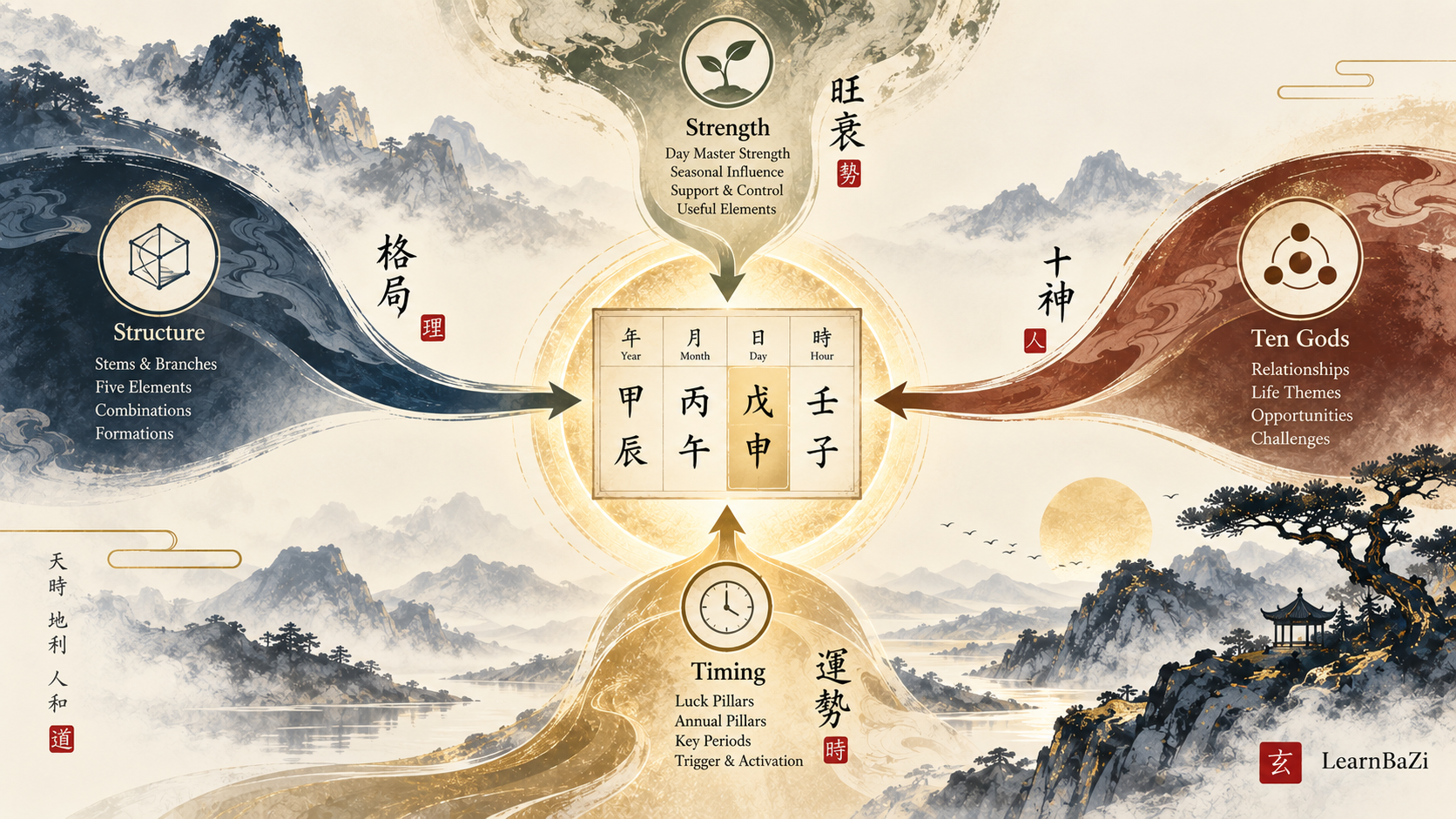
One may begin with Day Master strength. Another may place greater emphasis on the Month Branch, chart structure, Useful God or specific interactions within the chart.
So which method is correct?
The answer is not always as simple as choosing one technique and rejecting everything else. BaZi has developed through different schools, texts and teaching traditions, and those differences can affect how a chart is analysed.
Why Are There Different Ways to Read a BaZi Chart?
Different BaZi systems may emphasise different parts of the chart or organise their analysis in a different sequence. This can be confusing for beginners because the individual rules often sound familiar even when the overall methodology is different.
One teacher may tell you to begin with Day Master strength. Another may tell you to understand the Month Branch or chart structure first.
It is tempting to assume that one approach must therefore be correct and the other wrong. Sometimes, however, the methods are simply giving different importance to different parts of the chart.
Before comparing two methods, it helps to understand what each method is trying to assess and how its individual rules fit together.
Different Methods May Emphasise Different Questions
Imagine two doctors examining the same patient. One orders a blood test while another checks blood pressure. The tests are different because they are looking at different aspects of the same person.
BaZi can present a similar situation. A method used primarily to assess Day Master strength may organise the chart differently from a method focused more heavily on structure or another analytical concept.
This does not mean every method is equally useful in every situation. It means we need to understand the purpose and assumptions behind a method before comparing its conclusions.
Without that context, it is easy to compare two answers without realising that the practitioners did not arrive at them in the same way.
The Problem with Mixing Methods Too Early
Students today can learn BaZi from books, videos, courses, forums and social media. Access to information is useful, but it also creates a new problem: techniques from several schools can quickly become mixed together.
One source says an element is favourable. Another appears to say the opposite. One method produces a Strong Day Master while another method gives a Weak assessment.
The natural reaction is often to search for yet another rule that will settle the disagreement. That can create even more confusion.
A technique may make sense within the framework from which it came but behave differently when combined with assumptions from another system. For beginners, it is usually better to understand one coherent framework first before comparing it with others.
Consistency Matters
Knowing many BaZi rules does not automatically make someone a better chart reader. The more important skill is knowing how those rules relate to one another and when they should be applied.
A consistent method gives us a stable way to approach different charts. We should not completely change our reasoning from one chart to the next simply because a particular feature catches our attention.
This does not mean BaZi becomes mechanical. Every chart is different, and interpretation still requires judgement.
The value of a framework is that the reasoning remains clear enough for us to understand how a conclusion was reached.
Day Master Strength Is a Good Example
Day Master strength is one area where different methods can produce different answers. Some systems give greater weight to season, while others may emphasise roots, surrounding support or particular structural relationships.
That means two practitioners can recognise the same chart features yet still disagree about whether the Day Master is Strong or Weak.
The useful question is therefore not simply, “Who is correct?” A better question is, “How did each practitioner arrive at the assessment?”
Once we understand what evidence each method prioritises, the difference becomes much easier to study.
Useful God and Favourable Elements Can Differ Too
The same caution applies when discussing Useful God or favourable and unfavourable elements. Different schools may use these concepts within different analytical frameworks.
If one practitioner says Fire is favourable, the useful question is not simply whether Fire is “good.” We need to understand what role Fire is performing within that particular method.
What is it supporting, controlling or changing? Why has the practitioner selected it, and under what circumstances might the conclusion be different?
Those questions teach us much more than simply memorising that one element is favourable.
Should We Aim to Balance All Five Elements?
The idea of balancing the Five Elements is often used when BaZi is introduced to beginners. It is easy to understand, but it can become misleading if we assume that every chart should contain equal amounts of Wood, Fire, Earth, Metal and Water.
A chart does not automatically become better because all five elements are present. Likewise, a missing element does not necessarily mean that something must be added or corrected.
What matters is the role each element performs within the chart and the methodology being used to assess it.
This is another reason a clear framework matters more than simply counting elements.
Can More Than One Method Be Useful?
Yes, but comparison becomes much easier once you understand the individual methods properly. Experienced practitioners may eventually study several approaches and use them to examine a chart from different angles.
The important difference is that they usually know which assumptions belong to which system. A beginner may unknowingly combine them and assume every rule belongs to one universal method.
Think of learning languages. Once you understand the grammar of two languages, moving between them becomes manageable.
If you mix both before learning either one properly, the result becomes much harder to understand.
How Should a Beginner Choose a Method?
Start with a framework that explains its reasoning clearly. You should be able to understand what you are observing, why it matters and how one part of the analysis connects with the next.
The method should also encourage you to look at the chart as a whole rather than making major conclusions from one isolated feature.
Most importantly, practise with real charts. A method becomes much clearer when you apply it repeatedly and compare your observations with actual circumstances.
Over time, you will begin to understand not only what the method says, but where its strengths and limitations lie.
Do Not Judge a Method by One Impressive Prediction
A very specific prediction can be impressive, especially when it turns out to be correct. But one memorable result does not tell us whether the underlying methodology is consistently useful.
A good framework should help us understand many charts, not just produce an occasional dramatic answer.
It should also help us recognise when the evidence is unclear and when a more cautious interpretation is appropriate.
Knowing when not to make a strong conclusion is part of good BaZi practice too.
So, Is There a Best Way to Read a BaZi Chart?
I would be cautious about claiming that one method is universally superior in every situation. BaZi has developed through different traditions, and practitioners do not always organise their analysis in exactly the same way.
A more useful goal is to learn a method that is coherent, understandable and consistent enough that you can explain your reasoning.
Once that foundation is established, comparing other schools becomes much more meaningful. You can see where the methods agree, where they differ and what assumptions produce those differences.
That is far more useful than constantly searching for the next secret technique.
How We Approach BaZi at LearnBaZi
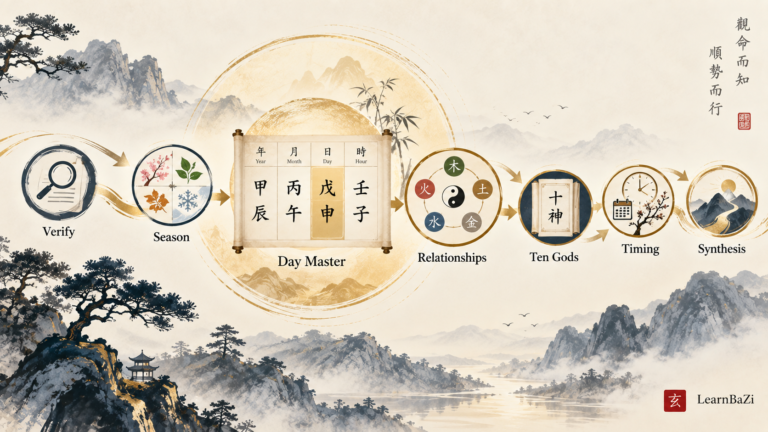
At LearnBaZi, the emphasis is on developing a systematic way of thinking about the chart. We begin with observable information, consider relationships within context and avoid making major conclusions from one isolated feature.
We also distinguish between what the chart shows and what we later interpret from it. That distinction becomes increasingly important as students move from basic concepts into deeper chart analysis and timing.
The full method involves more than a single public article can reasonably cover. The purpose here is simply to show why a clear analytical framework matters.
Once the framework is understood, advanced techniques become much easier to evaluate.
Build the Foundation Before Collecting More Techniques
When students first learn BaZi, they naturally want answers. Is the Day Master Strong or Weak? Which element is favourable? What will happen during the next Luck Pillar?
Those questions are understandable, but the quality of the answer depends on the method used to reach it.
Build the foundation first. Understand the framework, practise applying it and learn how different observations relate to one another.
Then, when you encounter another school or technique, you will have something meaningful against which to compare it.
Continue Learning
If you want to see how a BaZi reading can be organised without jumping randomly between chart features, continue with A Systematic Method for Reading a BaZi Chart.
If Day Master strength is the area where you have encountered the most conflicting opinions, read Day Master Strength in BaZi: Why Different Methods Give Different Answers. It explains why practitioners can recognise the same chart but weigh the evidence differently.
If you are still building your foundation, follow the LearnBaZi Learning Path or begin with BaZi Master Class — Level 1.
The objective is not to learn every BaZi method at once. Learn one framework well enough to understand why it works, then expand from there.