
If you have studied BaZi from more than one teacher, you may eventually encounter a confusing situation. One practitioner looks at a chart and says the Day Master is Strong, while another examines exactly the same chart and says it is Weak.
Both may be experienced practitioners. Both may point to genuine features in the chart, yet their conclusions are different.
Why does this happen?
Very often, the disagreement comes from the method being used, the factors being emphasised and the weight given to different parts of the chart. Understanding this is much more useful than simply deciding that one practitioner must be right and the other wrong.
What Is the Day Master?
The 日主 Rì Zhǔ, or Day Master, is the Heavenly Stem of the Day Pillar. It becomes the main reference point from which many elemental and Ten God relationships in a BaZi chart are understood.
When practitioners discuss Day Master strength, they are examining how well the Day Master is supported within the overall environment of the natal chart.
At LearnBaZi, the eventual classification is expressed as either Strong or Weak. These are technical descriptions rather than judgements about the person.
A Strong Day Master does not mean someone is stronger, more capable or more fortunate. A Weak Day Master does not mean the person lacks strength of character or is destined to struggle.
Why Does Day Master Strength Matter?
Strength gives us useful context for understanding how the Day Master relates to the other elements in the chart. It can later contribute to deeper analysis of how different relationships may function.
But knowing that a Day Master is Strong or Weak does not complete the chart reading. It does not automatically tell us about wealth, career, relationships or what will happen during a particular year.
It is one important assessment within a much larger system.
This distinction matters because students sometimes become so focused on deciding Strong or Weak that they begin treating the classification as the final answer. In reality, it is better thought of as part of the foundation for what comes next.
Why Can Different Methods Produce Different Answers?
Different BaZi schools do not always give the same importance to every piece of evidence. One method may place particularly strong emphasis on seasonal influence, while another may pay more attention to roots or the support surrounding the Day Master.
Practitioners may also differ in how they interpret certain combinations, hidden stems or other relationships within the chart. Even when they recognise the same features, they may not assign them the same significance.
That is why two practitioners can begin with the same Eight Characters and still arrive at different assessments.
The disagreement is often not about whether a particular element exists. It is about how much that element should matter within the complete chart.
Strength Is More Than Counting Elements
A common beginner approach is to count how many elements support the Day Master and compare them with how many weaken it. If there appear to be more supporting elements, the Day Master is then assumed to be Strong.
This is an understandable starting point, but BaZi is more nuanced than a simple headcount.
An element appearing once in an important seasonal position may not carry the same significance as another element appearing somewhere else in the chart. A rooted element is also different from one that appears visibly but has little foundation beneath it.
So the question is not simply, “How many supporting elements can I find?” We also need to understand the quality and context of that support.
Season Is an Important Part of the Picture
The Month Branch provides important information about the seasonal environment into which the Day Master is born. This is one reason season receives considerable attention in many BaZi methods.
For example, a Wood Day Master born during a period when Wood receives strong seasonal support begins from a different environment from the same Wood Day Master appearing in a season that is less supportive of Wood.
But season should not automatically become the entire assessment. The rest of the chart still matters.
A Day Master may receive seasonal support while facing substantial weakening influences elsewhere. Another may not be strongly supported by season but receive meaningful roots and support from other parts of the chart.
This is where different methodologies can begin to diverge.
Roots Add Another Layer
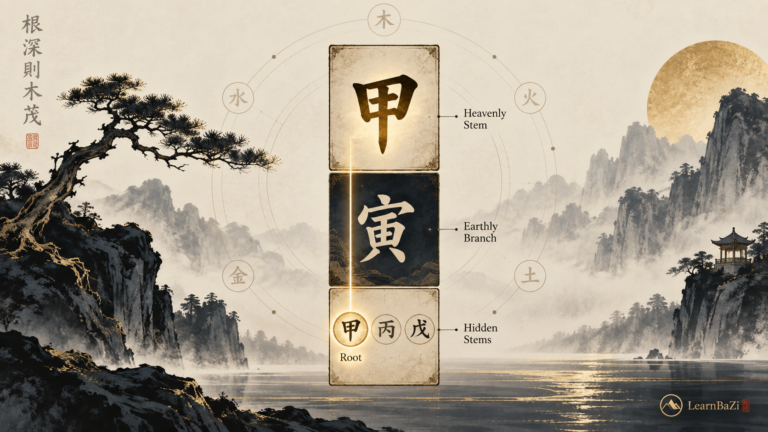
Rooting tells us whether the element represented by a Heavenly Stem also has corresponding presence within the Earthly Branches. When the Day Master is rooted, it has an underlying elemental foundation within the chart.
This matters, but rooting should not be confused with the final Strong or Weak assessment.
A Day Master may have roots and still be Weak after the broader chart is considered. Likewise, the absence of an obvious root does not allow us to ignore other forms of support.
If you want to understand rooting in more detail, read What Does It Mean for a Heavenly Stem to Be Rooted in BaZi?. That article looks specifically at the difference between rooting and other forms of support.
Support Is Not the Same as Rooting
Suppose the Day Master is Wood. Water generates Wood, so Water functions as Resource and can support the Wood Day Master.
But Water is not a Wood root. It provides a different type of support.
Companion elements can also contribute support because they belong to the same elemental family as the Day Master. Again, how much that support matters depends on the wider chart.
This is why it becomes useful to distinguish the different types of evidence rather than grouping everything supportive into one category.
What Weakens the Day Master?
We also need to recognise relationships that place demand on the Day Master. Output, for example, is produced by Self and therefore weakens Self.
Wealth also requires the Day Master to control another element, while Authority represents the element that controls the Day Master. These relationships can therefore contribute weakening influences within the chart.
The presence of Output, Wealth or Authority does not automatically make the Day Master Weak. Their actual significance depends on how they are positioned and supported within the wider chart.
The same principle applies to supportive elements. Presence alone is not enough; context matters.
Why Similar-Looking Charts Can Behave Differently
Imagine two charts that both contain a Wood Day Master, Water and additional Wood. At first glance, both appear to have similar supporting elements.
But suppose the first chart receives strong seasonal Wood support and meaningful roots, while the second chart places those same elements in a very different seasonal and structural environment.
The visible ingredients may look similar, yet their significance can be quite different.
This is one reason BaZi should not be reduced to counting elements or applying isolated rules. The relationships between the elements matter just as much as their presence.
Strong and Weak Do Not Mean Good and Bad
The English words “strong” and “weak” can easily create the wrong impression. In ordinary language, strong usually sounds positive while weak sounds negative.
That is not how these terms should be understood in Day Master analysis.
A Strong Day Master can still encounter difficult periods, poor decisions or challenging circumstances. A Weak Day Master can have a highly successful and fulfilling life.
The classification describes an elemental condition within the chart. It does not rank the quality of the person’s destiny.
Does a BaZi Chart Need All Five Elements?
Another common assumption is that a good chart should contain a balanced quantity of Wood, Fire, Earth, Metal and Water. If one element is missing, people sometimes assume that the missing element must automatically be added or strengthened.
BaZi is not simply an exercise in making the Five Elements numerically equal.
An element may be absent yet not necessarily create a problem. Another element may appear repeatedly but still perform a particular role that needs to be understood within the structure of the chart.
Rather than asking whether every element is present in equal quantity, it is more useful to ask what each element is doing within that particular chart.
Why Shortcuts Can Cause Confusion
Students naturally look for simple rules when learning something complex. Rules such as “born in season means Strong” or “rooted means Strong” are easy to remember.
They can also become misleading when treated as universal conclusions.
These rules usually point towards a genuine concept, but they describe only one part of the assessment. Once charts become more complex, competing influences appear and the simple rule may no longer be sufficient.
This is often the point where students feel that BaZi has become inconsistent. In reality, they may simply have reached the limit of a simplified rule.
How Should We Compare Two Different Strength Assessments?
If two practitioners disagree, begin by asking how each reached the conclusion. Did both give the same importance to season? How did they treat roots and other forms of support?
Did they consider weakening influences in the same way? Were certain relationships or combinations interpreted differently?
These questions reveal far more than simply comparing the final labels of Strong and Weak.
They show where the actual methodologies begin to diverge. Once you understand that point, the disagreement becomes much easier to study.
What Should a Beginner Focus On?
At the beginning, the goal should not be to memorise every exception or master every competing school. It is more useful to understand the main categories of evidence and learn why they matter.
Recognise the importance of season. Learn what rooting means. Distinguish direct roots from Resource support, and understand that Output weakens Self while other relationships can also affect the Day Master’s condition.
Then resist the temptation to decide the final answer from one feature alone.
The deeper skill lies in knowing how these different pieces of evidence should be weighed against one another. That is where a systematic assessment method becomes necessary.
Why a Consistent Method Matters
A useful strength method should allow you to explain why you reached your conclusion. If a chart is classified as Strong, you should be able to identify the evidence supporting that assessment.
The same should apply when the Day Master is Weak.
This does not mean that every chart will be easy. Some charts contain competing influences and sit much closer to the boundary than others.
Those difficult charts are often where a consistent method becomes most valuable. Instead of changing the rules whenever the answer is unclear, we can return to the underlying framework and examine the evidence more carefully.
The Real Question Is Not Just Strong or Weak
When students first learn Day Master strength, the final classification can feel like the most important part of the exercise. With experience, another question becomes just as important: why?
Why does the season matter in this chart? Where does the Day Master receive support? What is weakening it, and which influences deserve greater attention?
Once you start asking those questions, strength analysis becomes much more than attaching a label to the chart.
You begin learning how the different layers of BaZi interact.
Continue Learning
If Day Master strength is one of the areas you find most confusing, the next step is not simply to collect more Strong and Weak examples. The real value comes from learning how the different categories of evidence are brought together consistently.
The Strength of Day Master Specialist Course goes deeper into the assessment process, including how competing influences are evaluated and how more difficult charts are handled.
If you are still building your broader BaZi foundation, begin with BaZi Master Class — Level 1. Day Master strength makes much more sense when Heavenly Stems, Earthly Branches, Five Elements and Ten Gods are already familiar.
The important starting point is this: different practitioners may arrive at different answers because they are not always weighing the same evidence in the same way. Understanding that difference is the first step towards developing a method you can apply consistently.