A BaZi chart can contain a surprising amount of information. There are Heavenly Stems, Earthly Branches, hidden stems, Five Elements, Ten Gods, combinations, clashes, seasonal influences, Luck Pillars and many other relationships.
Learning what each of these concepts means is only the beginning. The harder question is knowing where to start, which observations deserve attention and how everything eventually fits together.
This is why a systematic approach matters. A good reading should not depend on spotting one interesting symbol and immediately building an interpretation around it.
Instead, we gradually move from understanding the chart to understanding the relationships within it, then consider how timing and the person’s actual question affect the picture.
Why BaZi Reading Can Feel Overwhelming
Beginners often experience the same problem. They learn one concept at a time and become reasonably comfortable identifying the Day Master, Ten Gods, combinations or clashes.
Then a complete chart appears in front of them and everything seems to be happening at once.
A clash may catch the eye. A particular Ten God may look important. One element appears repeatedly, while another seems to be missing completely.
The temptation is to interpret whichever feature looks most interesting first. This can produce plenty of observations, but those observations may not form a coherent reading.
There Is More Than One Way to Read a BaZi Chart
Different BaZi schools do not necessarily organise their analysis in exactly the same way. Some place greater emphasis on the Month Branch, while others focus more heavily on Day Master strength, structure, Ten Gods or particular analytical techniques.
This does not mean that a student has to decide immediately which school possesses the only correct sequence. It is more important to understand the framework being used and apply it consistently.
We explored this more fully in Is There a Best Way to Read a BaZi Chart?. For now, the important point is that random interpretation and systematic interpretation are very different things.
A systematic reading gives us a way to organise what we see before deciding what it means.
1. Start by Making Sure the Chart Is Correct
Before interpreting anything, the underlying chart needs to be reliable. An incorrect date, birth time, location or time-zone assumption can affect the Four Pillars and potentially everything that follows.
This becomes particularly important when the recorded birth time falls close to the boundary between two Chinese hours. In some cases, the difference between civil clock time and solar time may also deserve examination.
The LearnBaZi True Solar Time Calculator can help examine birth-time conditions, while the LearnBaZi BaZi Chart Generator provides the natal chart and major timing pillars.
There is little value in performing a sophisticated interpretation of the wrong chart. Good analysis begins with good information.
2. Understand the Chart Before Interpreting It
Once the chart is established, resist the urge to predict something immediately. First understand the environment and the main relationships that are actually present.
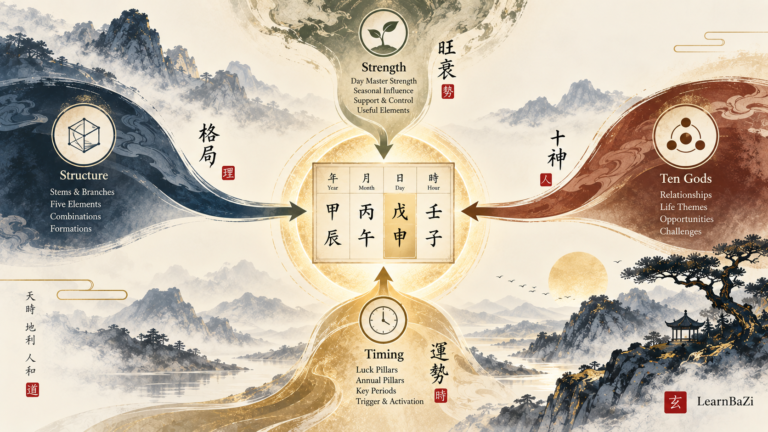
This includes recognising the Day Master, the seasonal context, the distribution of the Five Elements and the relationship between the Heavenly Stems and Earthly Branches.
The objective at this stage is not to explain the person’s entire life. It is to understand what kind of chart we are looking at.
For example, the same Fire element can have a very different significance depending on the season, its support and what surrounds it. Simply seeing Fire in the chart does not tell us enough.
Day Master Strength Is Part of the Context
In the LearnBaZi framework, understanding whether the Day Master is Strong or Weak gives us one important layer of context. But strength should not be decided from one isolated rule.
Season, roots, support and weakening influences can all contribute information. Some charts make the answer relatively obvious, while others contain competing evidence that requires much more careful analysis.
This is also why two practitioners can occasionally reach different conclusions about the same chart. You can explore that issue further in Day Master Strength in BaZi: Why Different Methods Give Different Answers.
For a public reading framework, the important point is simply this: establish the condition of the chart before trying to interpret what its individual parts mean.
3. Look for Relationships, Not Isolated Symbols
Once the basic chart context becomes clearer, we can begin looking at the relationships within it. This is where Heavenly Stems, Earthly Branches, Ten Gods, roots and interactions start to become meaningful.
A common mistake is to treat each feature as though it carries its own fixed prediction. A clash becomes a problem, Wealth becomes money, and Authority becomes career.
BaZi does not work quite so neatly.
Each relationship needs context. Where does it appear? What else is interacting with it? Is the element well established, or is it relatively weak within the chart?
A Clash Is a Good Example
Suppose 子 Zǐ and 午 Wǔ appear in the chart. We can observe that these two Earthly Branches form a clash relationship.
That observation is straightforward. What the clash means is not.
Its interpretation depends on where the branches appear, what they represent within that particular chart and what other relationships surround them. Timing may later make the interaction more significant as well.
Seeing a clash and immediately predicting a divorce, relocation or career change would therefore be jumping too quickly from observation to conclusion.
The Ten Gods Need Context Too
The same principle applies to the Ten Gods. Wealth, Resource, Output, Companion and Authority describe relationships relative to the Day Master, but they should not be reduced to one-word predictions.
Wealth does not automatically mean that money is coming. Output does not simply mean creativity, and Authority does not guarantee a promotion.
The useful question is how that relationship operates within the particular chart. Its condition, position and interaction with other elements all contribute to the eventual interpretation.
This is where BaZi reading gradually moves beyond memorising definitions and begins to require judgement.
4. Look for the Larger Pattern
A chart becomes easier to understand when we stop trying to interpret every character separately. Instead, look for themes that appear repeatedly or relationships that seem especially important.
Several different observations may begin pointing in the same direction. When that happens, the interpretation becomes more meaningful than a conclusion based on one isolated symbol.
For example, one feature may suggest increased responsibility. If several other relationships and later timing influences point towards similar themes, we have a stronger basis for exploring that interpretation.
If nothing else supports it, we should be more cautious. Good chart reading involves knowing when the evidence is strong and when we may be reading too much into one feature.
Not Everything in the Chart Needs Equal Attention
A BaZi chart may contain several combinations, clashes, hidden stems and Ten God relationships at the same time. That does not mean every one of them deserves an equally detailed interpretation.
The skill lies partly in recognising which relationships materially affect the question being studied.
A smaller number of meaningful observations is usually more useful than a long list of disconnected comments. This is one of the differences between identifying BaZi components and actually reading a chart.
The chart contains plenty of information. The practitioner still needs to decide what matters.
5. Add the Question and Timing
The same natal chart can be examined from different angles. A career question, relationship question and business question may direct our attention towards different parts of the chart.
The chart itself does not change. The analytical focus does.
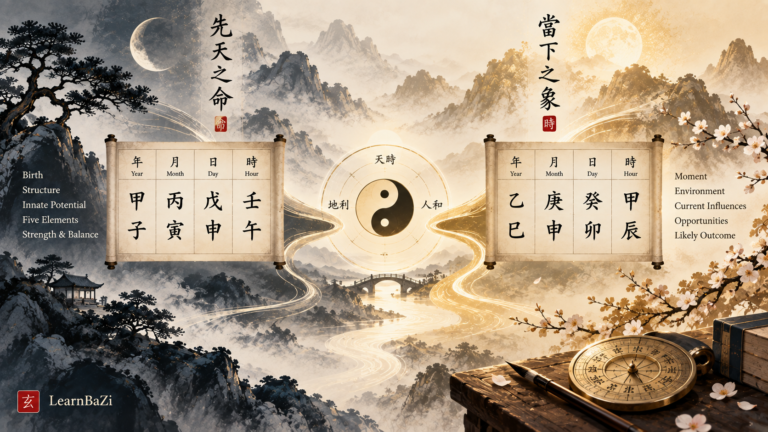
Timing adds another layer through Luck Pillars, annual pillars and other changing influences. These can strengthen or weaken existing relationships, introduce new interactions or make something already present in the natal chart more noticeable.
The important idea is that timing should be understood in relation to the natal chart. An incoming pillar does not suddenly replace the person’s original chart.
For Example, a Career Question
Suppose someone asks whether the next few years may bring significant career changes. We would not search for one character that simply means “new job.”
Instead, we consider the relevant natal relationships and then examine how the changing timing interacts with them. Perhaps certain themes become more active, or an existing relationship comes under greater pressure.
That gives us something useful to investigate.
It still does not mean one exact event must happen. BaZi can help us understand changing conditions without pretending that every symbol produces a guaranteed outcome.
The Hardest Part Is Bringing Everything Together
Students often discover that identifying individual BaZi relationships becomes easier long before synthesising them does. You may correctly recognise the Day Master, roots, Ten Gods and several interactions but still wonder what the chart is actually saying.
This is normal.
Synthesis is where separate observations begin to form a coherent picture. It requires us to decide which evidence matters most, which observations reinforce one another and which ones may modify the interpretation.
This is also one of the areas where deeper training and repeated case practice become important. There is a difference between knowing the ingredients and knowing how to use them together.
Observation Should Come Before Interpretation
One habit improves BaZi reading considerably: separate what you can observe from what you infer.
You may observe that a Stem has a root, that two branches clash or that a particular Ten God appears prominently. Those are chart observations.
What those observations mean for career, relationships, behaviour or timing requires another stage of reasoning.
This distinction helps reduce the tendency to make dramatic conclusions too early. It also makes your reasoning easier to review if later evidence points in another direction.
Why Practising with Real Charts Matters
BaZi eventually needs to move beyond theory. Once you understand a concept, compare it with real charts and real experiences.
You may discover that an interpretation you expected to be important was actually minor, while something you initially overlooked turned out to matter much more.
That feedback gradually develops judgement. Over time, patterns that once required several deliberate analytical steps may become easier to recognise.
What appears to be practitioner intuition is often built from years of structured observation and repeated case experience.
A Simple Public Framework
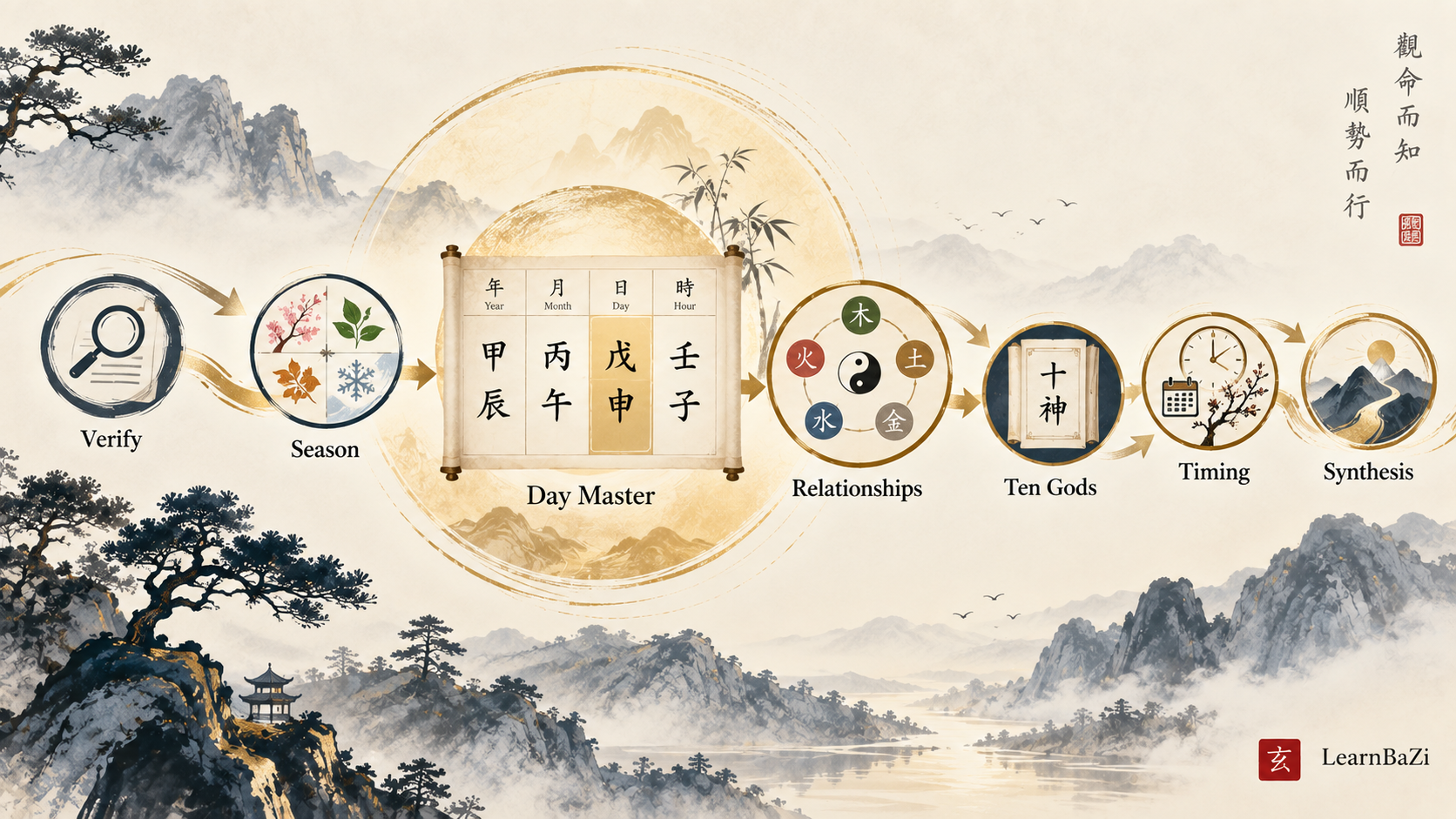
If you are beginning to read charts, you can think about the process in five broad phases:
- Verify the chart. Make sure the underlying Four Pillars and timing information are reliable.
- Understand the natal context. Establish the general environment and important structural features before interpreting them.
- Examine the relationships. Look at how the elements, Ten Gods, Stems and Branches interact rather than treating them separately.
- Introduce the question and timing. Focus on what is relevant and see how changing influences interact with the natal chart.
- Bring the evidence together. Look for recurring patterns and avoid basing major conclusions on one isolated feature.
This is intentionally a broad framework rather than a complete chart-reading checklist. Each stage contains deeper analytical questions that become more important as your BaZi knowledge develops.
The purpose is to understand the shape of a good reading before trying to master every technique within it.
Systematic Does Not Mean Mechanical
A systematic method does not mean that every chart must be interpreted with identical wording. BaZi charts contain different relationships, and experienced practitioners still need judgement.
The structure gives us discipline. It helps prevent us from changing the rules every time we encounter a difficult chart or allowing one interesting feature to dominate everything else.
As experience grows, the framework becomes less visible because many of the analytical steps become familiar. The practitioner may move through the chart quickly, but the underlying reasoning is still there.
Structure and intuition are not opposites. Good intuition often develops from repeatedly applying a sound structure.
The Goal Is Not to Memorise More Rules
Learning BaZi can easily become a collection exercise. Students gather more combinations, more meanings, more formulas and more interpretations, hoping that one additional rule will suddenly make every chart clear.
Usually, the breakthrough comes from somewhere else.
It comes from learning how to organise what you already know. You begin recognising which observations deserve attention, how they connect and when there is enough evidence to support a conclusion.
That is when BaZi starts becoming a method of analysis rather than a collection of individual rules.
Continue Learning
If you are still building your foundation, follow the LearnBaZi Learning Path. It introduces the major concepts progressively before moving into deeper chart interpretation and timing.
The BaZi Master Class — Level 1 develops these foundations in a structured learning sequence so that concepts such as the Day Master, Five Elements, Ten Gods, Heavenly Stems and Earthly Branches can eventually be brought together.
If Day Master strength is currently the part you find most difficult, the Strength of Day Master Specialist Course goes deeper into that specific assessment and the competing evidence that needs to be considered.
A public article can show you the shape of a systematic BaZi reading. Developing the ability to perform that reading consistently comes from understanding the individual layers, practising them and eventually learning how to bring them together.