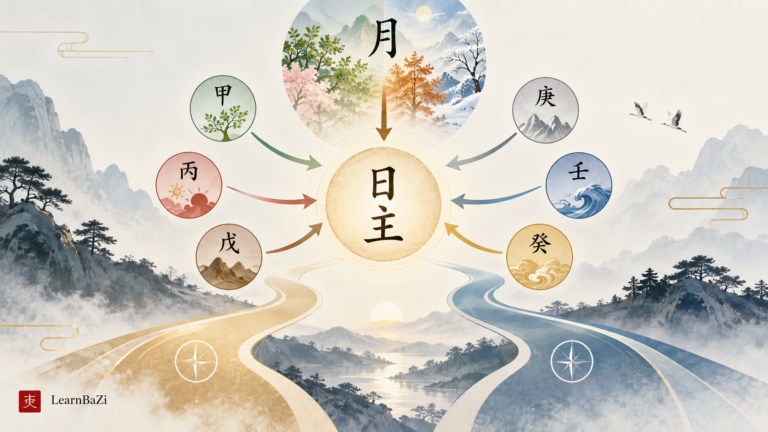
What Does It Mean for a Heavenly Stem to Be Rooted in BaZi?
When a BaZi practitioner says that a Heavenly Stem is “rooted”, what does that actually mean?
In simple terms, a Heavenly Stem is rooted when its own element is also present within one or more Earthly Branches through their hidden stems.
That root gives the visible stem a foundation in the lower part of the chart.
But having a root does not automatically mean that the stem is strong.
To understand rootedness properly, we need to look at where the root comes from, how strong that root is, whether it receives seasonal support, and whether other chart interactions weaken or alter it.
What Is a Root in BaZi?
The concept of root connection is commonly described as 通根 Tōng Gēn — connecting to a root.
The Heavenly Stems appear at the top of the Four Pillars.
The Earthly Branches appear below them.
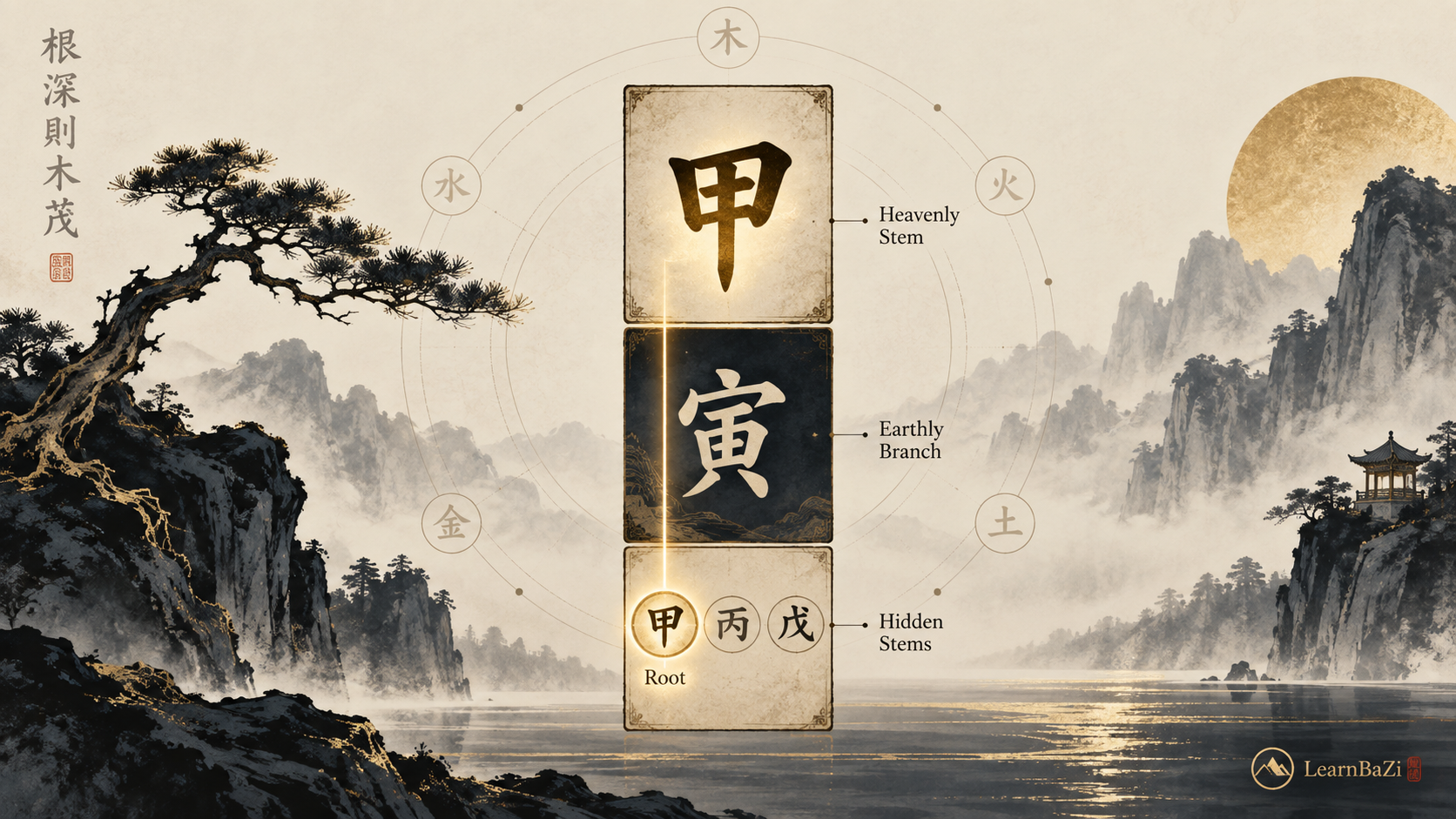
Inside each Earthly Branch are one or more 藏干 Cáng Gān — Hidden Stems.
If a visible Heavenly Stem finds the same element among those hidden stems, it has a root.
For example, if 甲 Jiǎ — Yang Wood appears as a Heavenly Stem and one of the Earthly Branches contains Wood among its hidden stems, that visible Wood has branch-level support.
The same principle applies to the other elements.
Why Roots Matter
A visible Heavenly Stem may appear prominent because it sits openly at the top of the chart.
But visibility does not necessarily mean strength.
A stem that has support below the surface of the chart is in a different condition from a stem that appears without any same-element foundation in the branches.
Roots therefore help us answer questions such as:
- Does this stem have structural support?
- Is the element anchored in the chart?
- How much branch-level foundation does it have?
- Can it sustain its influence when other forces act upon it?
This becomes especially important when assessing the Day Master.
Hidden Stems Are Where Roots Are Found
Each Earthly Branch contains one or more Hidden Stems.
For example:
寅 Yín — Tiger contains 甲 Jiǎ Wood, 丙 Bǐng Fire and 戊 Wù Earth.
So a visible 甲 Jiǎ Wood stem can find Wood support in 寅 Yín.
Likewise, a visible 丙 Bǐng Fire stem can also find Fire support there.
This is why an Earthly Branch cannot always be treated as if it contains only one simple element.
Its hidden structure matters.
Same Element Does Not Mean Same Strength
Not every root has the same quality.
A root found in the principal qi of a branch is generally more substantial than one found only in a secondary or residual layer.
Likewise, a root that is seasonally supported may operate differently from one that is out of season.
So instead of asking only:
“Does this stem have a root?”
we should also ask:
“What kind of root is it?”
Main, Secondary and Residual Root Qi
Hidden stems are commonly organised into different layers.
The main qi represents the dominant internal element of the branch.
Some branches also contain secondary or residual qi.
This means a stem may have:
- a strong, direct root;
- a secondary root;
- a weaker residual root.
The distinction matters because the mere presence of a same-element hidden stem does not tell us the whole story.
Rootedness is not simply a yes-or-no calculation.
Root Is Not the Same as Resource Support
This is an important distinction.
Suppose the Day Master is Wood.
Water generates Wood, so Water supports Wood.
But Water is not itself Wood.
Therefore, in the stricter LearnBaZi usage:
Water is Resource support for Wood.
It is not the Wood root itself.
A Wood root is found where Wood exists within the Earthly Branches.
This distinction helps prevent two separate ideas from being mixed together:
having support
and
having roots.
Both matter, but they are not the same thing.
LearnBaZi Method Note
When assessing roots, separate three questions:
Does the stem have a root?
How strong or usable is that root?
What other support does the stem receive?
Do not combine all three into one vague idea of “strength”.
Rootedness is evidence.
It is not the final verdict.
Can the Root Be in Any Earthly Branch?
A Heavenly Stem may find roots in more than one branch.
The root does not always have to sit directly beneath the same stem.
However, location can still matter.
A root in the same pillar or a nearby pillar may have a more direct structural relationship than a distant or weak root elsewhere in the chart.
The Month Branch also deserves special attention because it carries the seasonal environment.
This is why root location should be recorded rather than simply counted.
Does the Month Branch Give a Stronger Root?
The Month Branch is especially important because it represents 月令 Yuè Lìng — Month Command and therefore the seasonal climate.
A root located there may carry both root support and seasonal significance.
But that does not mean every Month Branch root automatically overrides all other evidence.
The overall chart still matters.
We must examine the root together with:
- season;
- hidden-stem layer;
- other supporting elements;
- draining or controlling forces;
- combinations and clashes;
- the overall structure.
What Happens If a Stem Has Several Roots?
Multiple roots may provide stronger structural support than a single weak root.
But again, we should not simply count them.
Three weak roots are not automatically equivalent to one strong seasonal root.
The quality of each root matters.
So the better question is not:
“How many roots are there?”
but:
“What kind of root support does this stem actually have?”
Can a Root Be Weakened?
Yes.
A root exists within an Earthly Branch, and Earthly Branches can interact with one another.
Depending on the method being used, combinations, clashes and other interactions may alter how accessible or effective that root becomes.
This does not mean every clash automatically destroys a root.
Nor does every combination automatically remove it.
The effect must be analysed in context.
How to Evaluate Root Quality
A practical root assessment can be done in several stages.
First, identify the visible Heavenly Stem you are evaluating.
Next, examine all four Earthly Branches and open their Hidden Stems.
Then ask whether the same element appears among those hidden stems.
After identifying the root, assess:
- whether it is main, secondary or residual qi;
- whether it receives seasonal support;
- where it is located;
- whether there are multiple roots;
- whether branch interactions affect it;
- what additional Resource or Companion support exists.
Only after that should rootedness be incorporated into the larger strength assessment.
LEARNBAZI COURSE
Want to Learn How Roots Fit into Day Master Strength?
The Strength of Day Master course teaches a structured method for evaluating season, roots, Heavenly Stems, Earthly Branches, combinations and transformations.
Explore the Strength of Day Master Course →
Common Mistakes When Reading Roots
One common mistake is to assume:
“The Day Master has a root, therefore it is Strong.”
That conclusion is too fast.
Another mistake is:
“The Day Master has no root, therefore it must be Weak.”
That can also be too simplistic.
A Day Master may receive substantial seasonal or Resource support even without a strong direct root.
Likewise, a rooted Day Master may still be heavily drained or controlled.
Rootedness is one part of the evidence.
Rooted Does Not Mean Favourable
Another important distinction is between strength and favourability.
A rooted element may be strong.
But that does not automatically mean the element is beneficial to the chart.
Likewise, an unrooted element is not automatically harmful.
The question:
“Does this element have roots?”
is different from:
“Is this element useful or favourable?”
Those questions belong to different stages of analysis.
Why Rootedness Matters for Day Master Strength
When assessing Day Master strength, roots help us understand whether the Day Master has a structural foundation in the Earthly Branches.
This is often considered alongside:
- seasonal command;
- Resource support;
- Companion support;
- draining elements;
- controlling elements;
- chart interactions.
The stronger the foundation, the more confidently we can say that the Day Master has branch-level support.
But the final Strong-or-Weak assessment must still consider the entire chart.
A Simple Example
Imagine a 甲 Jiǎ Wood Day Master.
If one of the Earthly Branches contains Wood in its hidden stems, the Day Master has a root.
If that Wood is found as the main qi of a strong seasonal branch, the root may be substantial.
If the only Wood appears as weak residual qi in a branch that is heavily affected by other interactions, the root may contribute much less.
Both cases may technically contain Wood.
But they should not automatically be treated as equal.
The Key Takeaway
A rooted Heavenly Stem is a stem that finds same-element support within the hidden stems of the Earthly Branches.
But rootedness is not simply a yes-or-no label.
We should examine:
- where the root is,
- how strong the hidden qi is,
- whether the season supports it,
- whether other interactions affect it,
- and what other support the stem receives.
Most importantly:
having a root does not automatically mean being strong.
Rootedness is one piece of the evidence used to understand the condition of a Heavenly Stem and, in particular, the Day Master.
Continue Learning
To see how roots fit into the larger strength assessment, read:
Day Master Strength in BaZi: Why Different Methods Give Different Answers
If you want to learn the complete process for evaluating Day Master strength, continue with the Strength of Day Master course.