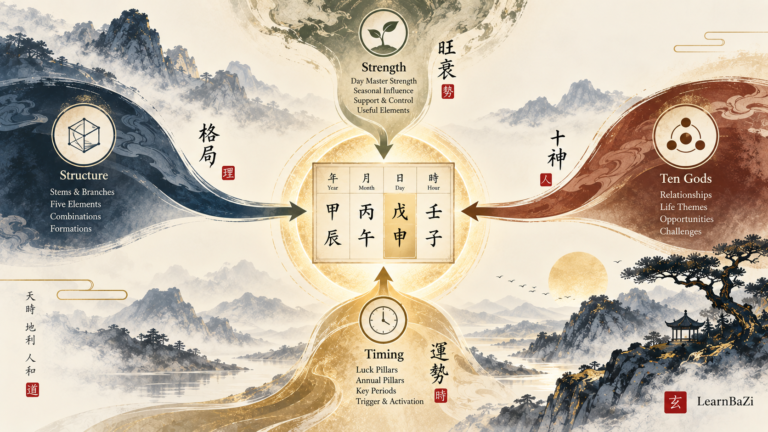

When you generate a BaZi chart, you may notice smaller characters beneath each Earthly Branch. Why do some branches have one, while others have two or three?
These are hidden stems: the Heavenly Stems traditionally associated with each Earthly Branch. They describe the branch’s internal elemental composition within the BaZi system. They do not add extra pillars to your chart.
Understanding this row helps you move beyond reading only the animal names. You can identify which elements are represented inside a branch and begin to understand how the visible stems connect with the branch layer.
Start by learning to locate and name these components. Assessing their strength comes later.
Where do you find hidden stems in a BaZi chart?
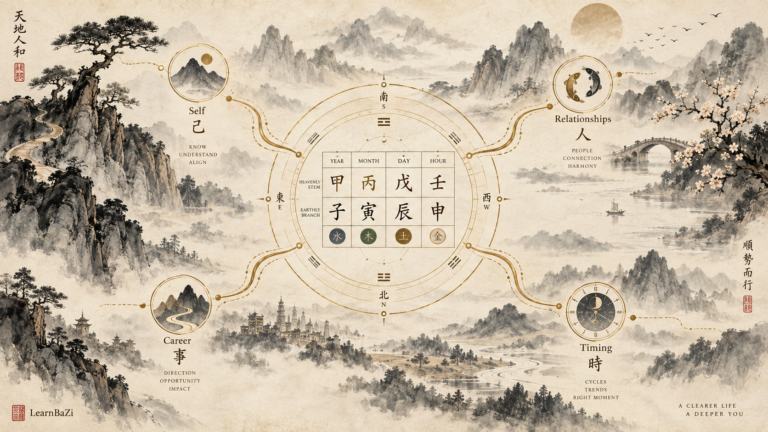
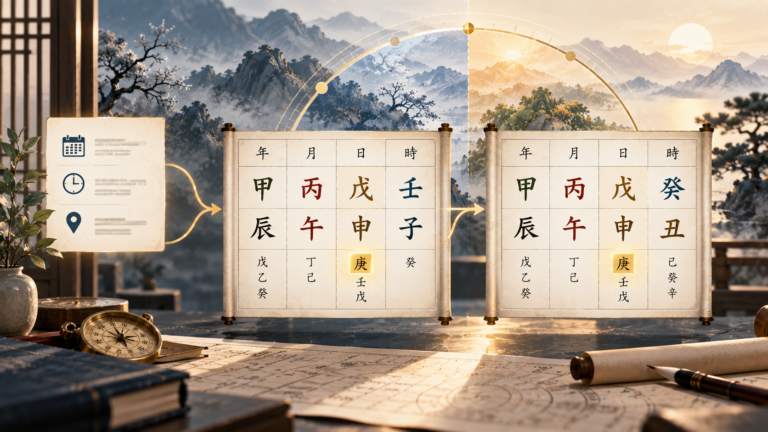
A natal BaZi chart has four pillars: Year, Month, Day and Hour. Each pillar has a visible Heavenly Stem above an Earthly Branch. Calculators may display the branch’s hidden stems underneath it or in an expanded details panel.
Open the LearnBaZi Chart Generator and look for the section labelled Hidden Stems beneath a natal pillar. Read one pillar at a time rather than trying to interpret the entire chart immediately.
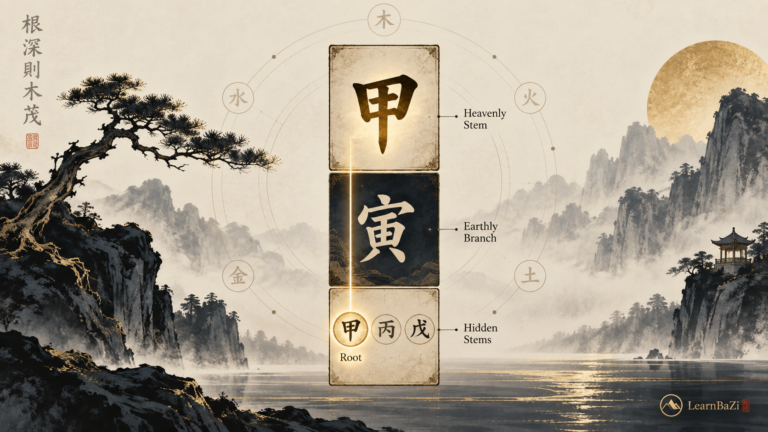
Here is an illustrative pillar, using 甲 (Jiǎ — Yang Wood) above 寅 (Yín — Tiger):
甲
Jiǎ — Yang Wood
寅
Yín — Tiger
甲 (Jiǎ — Yang Wood)
丙 (Bǐng — Yang Fire)
戊 (Wù — Yang Earth)
One pillar, with its branch’s internal components shown below.
| Layer | What appears | What it represents |
|---|---|---|
| Visible Heavenly Stem | 甲 (Jiǎ — Yang Wood) | The stem at the top of this pillar |
| Earthly Branch | 寅 (Yín — Tiger) | The branch below it, generally associated with Wood |
| Hidden stems | 甲 (Jiǎ — Yang Wood), 丙 (Bǐng — Yang Fire), 戊 (Wù — Yang Earth) | The stems associated with the Tiger branch |
The visible stem and the hidden-stem list answer different questions. The first identifies what appears at the top of the pillar. The second identifies what is contained within its branch.
The same stem can appear in both places. That is a structural connection to examine, rather than an accidental duplication to remove.
Why a Wood branch can contain Fire and Earth
Calling Tiger a Wood branch is useful shorthand. It does not mean that Wood is the only element represented within it.
In the example above, its hidden stems represent Wood, Fire and Earth. By contrast, 子 (Zǐ — Rat), generally associated with Water, contains just 癸 (Guǐ — Yin Water).
This is why reading only the branch’s animal or general element can miss information. Two branches may differ both in their main elemental association and in the stems listed inside them.
It also explains why counting the number of entries is misleading. Three hidden stems do not make Tiger “three times stronger” than Rat. The list identifies components; it is not a strength score.
Keep this distinction: “Which stems are present?” is a lookup question. “How influential are they here?” is an analysis question.
Why are particular stems associated with a branch?
The hidden-stem lists come from BaZi’s traditional model of seasonal change. Earthly Branches represent stages of the annual cycle as well as animals. Their hidden stems reflect ideas about which elemental influences are dominant, lingering, emerging or being stored.
For example, 辰 (Chén — Dragon) corresponds to late spring. Its hidden stems are:
- 戊 (Wù — Yang Earth): the branch’s main Earth component.
- 乙 (Yǐ — Yin Wood): the remaining influence of spring Wood.
- 癸 (Guǐ — Yin Water): the branch’s traditional association with the storage of Water.
This explains why calling it an Earth branch does not tell us everything it contains. The list brings together its main element, the season’s remaining influence and a storage association within the traditional system.
These are inherited correspondences, not ingredients measured inside a month or calculated separately for each person. There is no single rule such as “every branch contains the element that produces it” that derives the whole table. Detailed explanations and seasonal allocation methods also vary between schools.
For now, use this seasonal framework to understand the table rather than memorising an unexplained list. Once a branch is identified, its basic hidden-stem list is the same wherever it appears in the chart.
Hidden stems reference table
Use this table to look up one branch at a time. Each entry includes the character, pronunciation, and the element’s Yin or Yang polarity.
| Earthly Branch | Hidden stems |
|---|---|
| 子 (Zǐ — Rat) | 癸 (Guǐ — Yin Water) |
| 丑 (Chǒu — Ox) | 己 (Jǐ — Yin Earth), 癸 (Guǐ — Yin Water), 辛 (Xīn — Yin Metal) |
| 寅 (Yín — Tiger) | 甲 (Jiǎ — Yang Wood), 丙 (Bǐng — Yang Fire), 戊 (Wù — Yang Earth) |
| 卯 (Mǎo — Rabbit) | 乙 (Yǐ — Yin Wood) |
| 辰 (Chén — Dragon) | 戊 (Wù — Yang Earth), 乙 (Yǐ — Yin Wood), 癸 (Guǐ — Yin Water) |
| 巳 (Sì — Snake) | 丙 (Bǐng — Yang Fire), 戊 (Wù — Yang Earth), 庚 (Gēng — Yang Metal) |
| 午 (Wǔ — Horse) | 丁 (Dīng — Yin Fire), 己 (Jǐ — Yin Earth) |
| 未 (Wèi — Goat) | 己 (Jǐ — Yin Earth), 丁 (Dīng — Yin Fire), 乙 (Yǐ — Yin Wood) |
| 申 (Shēn — Monkey) | 庚 (Gēng — Yang Metal), 壬 (Rén — Yang Water), 戊 (Wù — Yang Earth) |
| 酉 (Yǒu — Rooster) | 辛 (Xīn — Yin Metal) |
| 戌 (Xū — Dog) | 戊 (Wù — Yang Earth), 辛 (Xīn — Yin Metal), 丁 (Dīng — Yin Fire) |
| 亥 (Hài — Pig) | 壬 (Rén — Yang Water), 甲 (Jiǎ — Yang Wood) |
The first stem listed is the branch’s main hidden stem. The remaining entries identify additional stems; this table does not assign them fixed percentages or equal influence.
You may encounter references that arrange the additional stems differently. Compare the actual contents before treating a difference in display order as a different chart.
Are hidden stems the same as roots?
They are related, but the terms describe different things.
Hidden stems describe what a branch contains. Rooting describes a connection between a Heavenly Stem and the same element within the branches.
Return to the illustrative Wood-over-Tiger pillar. Its visible stem is Yang Wood, and its branch also contains Yang Wood. This gives us a clear starting example of a stem with a corresponding root beneath it.
The Fire and Earth in that branch are also hidden stems. Their presence does not make them Wood roots: they belong to different elements.
Rooting can be examined across the chart, not only directly below a visible stem. How meaningful a root is requires further assessment, including the seasonal environment and wider chart relationships.
For that next step, read what it means for a Heavenly Stem to be rooted. That article develops the distinction between rooting, support and overall strength.
What if your calculator shows Ten Gods beside the hidden stems?
Some charts add a Ten God label beside each hidden stem. That label describes the stem’s relationship to the Day Master—the Heavenly Stem of the Day Pillar.
The branch’s basic hidden-stem list stays the same when the Day Master changes. The relationship labels may change because the reference point has changed.
For now, keep two observations separate: which stem is listed, and how it relates to the Day Master. You do not need to learn every relationship label before you can use the reference table correctly.
Try this with one pillar in your chart
Use your natal chart for this exercise, rather than a Luck or Annual Pillar:
- Choose one pillar. Start with whichever has the clearest display.
- Identify its Earthly Branch. Match the character and animal with the table above.
- Copy its hidden stems. Write each stem’s name, element and polarity.
- Compare the visible stem. Is its element also represented within this branch? Record what you find without assigning a strength score.
For the Wood-over-Tiger example, your note would read: “The visible stem is Yang Wood. The branch contains Yang Wood, Yang Fire and Yang Earth. Wood is represented at both levels.”
That is already a useful observation. “This must be a strong chart” or “this guarantees a particular outcome” would go beyond what this exercise establishes.
Once you can read one pillar comfortably, repeat the process with the other three. You are building a map of the chart’s components before attempting a full interpretation.
Your next step
You do not need to memorise all twelve lists today. Use the table to recognise what is present in your own chart, then follow the connection that becomes relevant.
If your next question is how a visible stem connects with the branches, continue with the rooting guide linked above. If you need a broader starting point, the Learn BaZi learning path places these concepts within a structured introduction.