If you have studied BaZi for some time, you may eventually encounter an interesting problem.
One teacher tells you that determining the strength of the Day Master is essential. Another says that you do not need to classify the Day Master as Strong or Weak before reading a chart.
Then you may encounter two practitioners looking at the same BaZi chart and arriving at different assessments of its strength.
So who is correct?
The answer is not simply that one person is right and the other is wrong. Very often, the difference comes from the method being used, the factors being emphasised, and the analytical question being asked.
Understanding this distinction can prevent a great deal of confusion when learning BaZi.
What Is the Day Master?
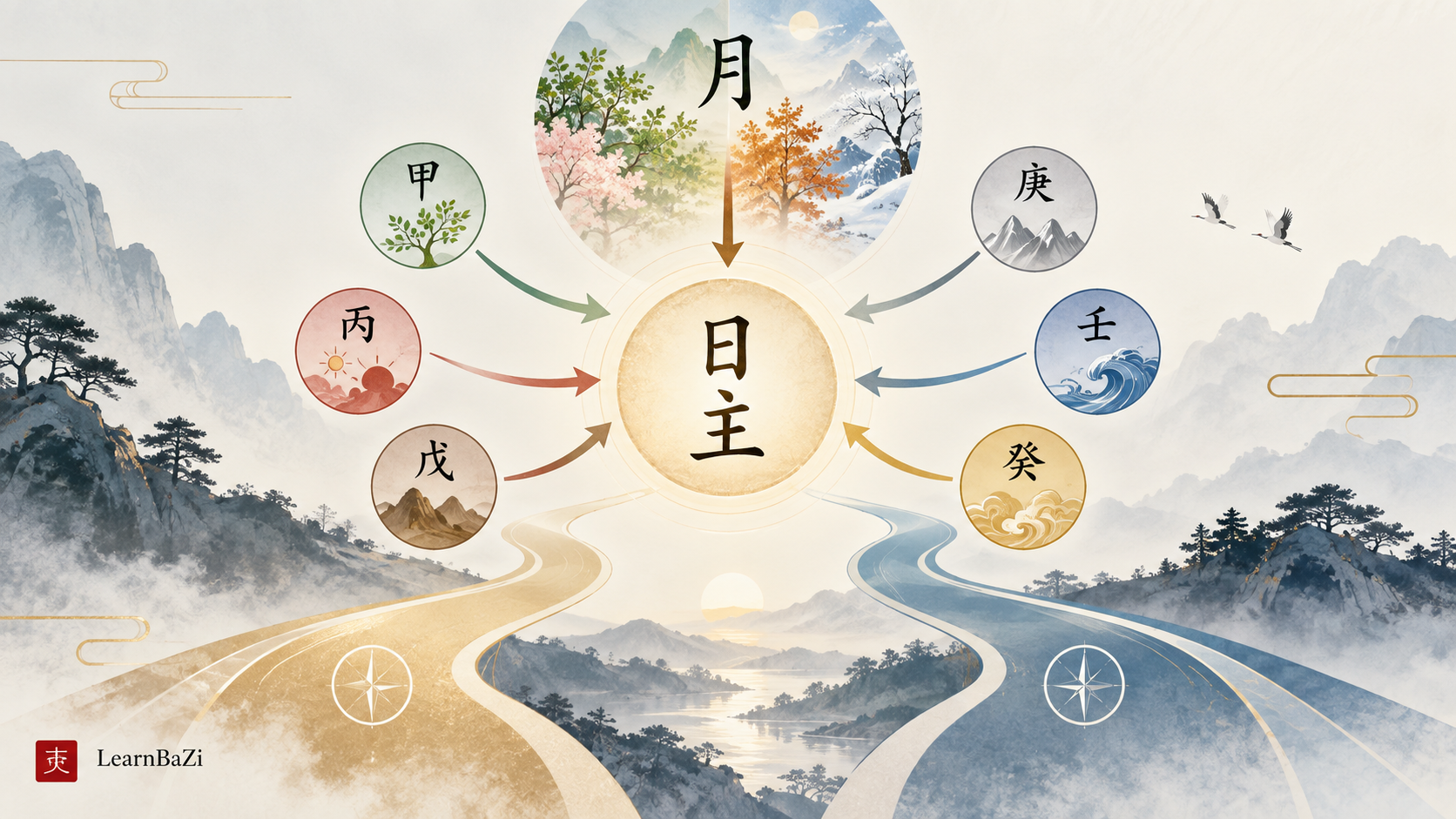
The 日主 Rì Zhǔ — Day Master is the Heavenly Stem of the Day Pillar.
It becomes the central reference point from which many relationships in the BaZi chart are examined.
A Day Master belongs to one of the Five Elements — Wood, Fire, Earth, Metal or Water — and also carries either Yin or Yang polarity.
When we speak about Day Master strength, we are asking a specific question:
How much support, foundation and effective strength does the Day Master have within the environment of the chart?
This is different from asking whether the person is strong-willed, successful, healthy or fortunate.
A 身强 Shēn Qiáng — Strong Day Master does not automatically indicate a better life.
Likewise, a 身弱 Shēn Ruò — Weak Day Master does not mean that the person is weak, unsuccessful or disadvantaged.
Strength is an analytical condition within the chart.
Why Day Master Strength Creates So Much Confusion
One common mistake is to think that Day Master strength can be determined simply by counting how many elements support the Day Master and how many oppose it.
BaZi is more complicated than that.
Five Elements appearing in different positions do not necessarily carry equal influence.
Season matters.
Roots matter.
Whether an element is visible or hidden matters.
Combinations, clashes and transformations may also change how certain forces operate.
This is why two charts containing similar numbers of Wood, Fire, Earth, Metal and Water can still behave very differently.
It is also why two assessment methods may appear to reach different conclusions even though both are examining legitimate aspects of the chart.
Start with the Month Command and Season
One of the first factors traditionally examined is the 月令 Yuè Lìng — Month Command, represented by the Month Branch.
The Month Branch tells us about the seasonal environment into which the Day Master is born.
A Day Master that receives strong seasonal support is often described as 得令 Dé Lìng — obtaining the seasonal command.
This can give the Day Master a substantial foundation.
Conversely, a Day Master born in a season where its element is weak, restrained or exhausted begins from a different position.
But season alone should not automatically settle the entire assessment.
A Day Master that is out of season may still have substantial roots and support elsewhere in the chart.
Likewise, a Day Master that receives seasonal support may still be affected by strong draining, controlling or transforming influences.
The Month Command is therefore extremely important, but it should be read as part of the entire chart.
Roots and Support Matter Too
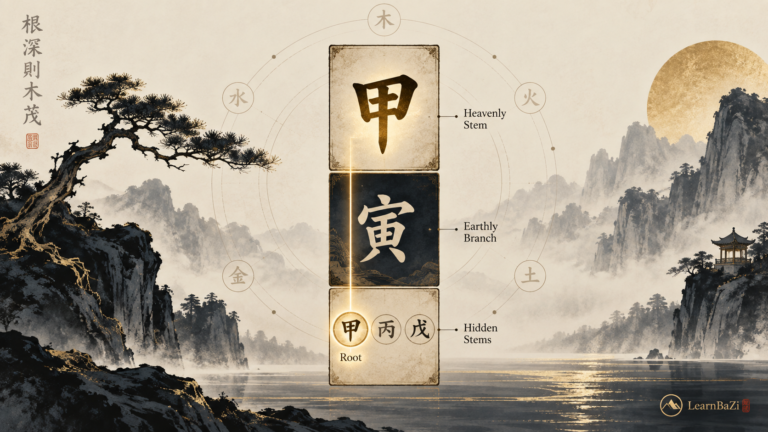
The next question is whether the Day Master has support within the Earthly Branches.
This is sometimes described as 得地 Dé Dì — obtaining ground.
A Heavenly Stem with meaningful roots in the branches has a different foundation from one that appears above the chart without comparable support below.
This is why understanding hidden stems and root relationships becomes important when assessing strength.
We then examine the other visible Heavenly Stems and the overall forces surrounding the Day Master.
Support from Resource and Companion elements may strengthen the Day Master, while Output, Wealth and Authority relationships may drain or control it depending on the chart.
This broader supporting momentum is sometimes described as 得势 Dé Shì — obtaining momentum or support from the surrounding forces.
The important point is that strength is not a simple headcount.
We are evaluating the quality, position and condition of the support.
LEARNBAZI METHOD NOTE
Before applying a BaZi rule, identify what question the method is designed to answer.
Apparent contradictions often arise when rules from different analytical frameworks are mixed together.
Why Different BaZi Methods May Emphasise Different Factors
This is where the original confusion often begins.
Different schools of BaZi do not always organise their analysis in exactly the same sequence.
Some approaches place considerable emphasis on determining whether the Day Master is Strong or Weak before progressing further.
Other approaches may begin with the Month Command, chart structure, visible relationships, imagery or a particular event question.
Some practitioners use strength primarily as part of balancing analysis.
Others may use strength as one factor among several when analysing structure and relationships.
There are also specialised reading techniques in which making a binary Strong-or-Weak classification is not the first analytical step.
The mistake is therefore not necessarily using one method instead of another.
The mistake is mixing the rules of different methods without understanding what each method is designed to do.
At LearnBaZi, we prefer to make the analytical framework explicit.
Before applying a rule, ask:
What question is this method trying to answer?
That question often resolves what first appears to be a contradiction.
Strong and Weak Are Not the Final Interpretation
Another important distinction is that Day Master strength is normally an intermediate assessment, not the final conclusion of a BaZi reading.
Knowing that a Day Master is Strong or Weak does not by itself tell us the person’s career, relationships, wealth or future events.
It gives us information about the operating condition of the Day Master.
What we do with that information depends on the next analytical layer.
For example, some balancing approaches use strength as an important consideration when examining which elements may help regulate the chart.
This may eventually lead into concepts such as 用神 Yòng Shén — Useful God, but Useful God selection should not be reduced to the simplistic formula:
“Strong Day Master = weaken it. Weak Day Master = strengthen it.”
Real charts can involve structure, seasonal conditions, combinations, transformations and special configurations that require a more careful assessment.
This is why establishing the methodology matters.
The Same Chart Can Be Examined for Different Purposes
Suppose we are studying a natal chart and asking whether the Day Master has sufficient support.
We would examine season, roots, surrounding support and the forces draining or controlling it.
But imagine that our question is much narrower:
Is this particular Heavenly Stem rooted?
Now the analytical focus changes. We would concentrate more specifically on the relevant Earthly Branches and their hidden stems.
Or suppose we are examining a Luck Pillar or Annual Pillar.
The incoming pillar may provide additional support, introduce a new root, create a combination or activate an existing relationship.
That does not necessarily mean we should erase the natal assessment and declare that the birth chart has permanently become a different chart.
Instead, we examine how the incoming timing influence changes the operating environment.
The question determines the level of analysis.
A Better Way to Assess Day Master Strength
Rather than memorising a single numerical formula, I recommend thinking through Day Master strength in stages.
Begin with the Day Master and its elemental nature.
Then examine the Month Command and seasonal condition.
Next, check whether the Day Master is rooted in the Earthly Branches and consider the quality and position of those roots.
After that, assess visible and hidden support, together with the forces that drain, control or transform the Day Master.
Finally, consider important interactions and whether the chart falls outside an ordinary Strong-or-Weak framework.
Only after this should we decide how the strength assessment is relevant to the question we are trying to answer.
This produces a much more consistent analysis than simply counting elements.
LEARNBAZI COURSE
Want to Learn the Complete Assessment Process?
The LearnBaZi Strength of Day Master course teaches a structured method for evaluating season, roots, Heavenly Stems, Earthly Branches, combinations and transformations step by step.
Why LearnBaZi Teaches Day Master Strength Systematically
The purpose of learning Day Master strength is not to attach a permanent label to a person.
It is to develop an analytical skill.
When students learn to examine season, roots, support and chart interactions systematically, they begin to understand why different parts of a BaZi chart carry different weight.
That skill becomes useful later when studying Ten Gods, structures, favourable and challenging influences, Luck Pillars and more advanced analysis.
It also makes disagreements between different methods much easier to understand.
Instead of asking:
“Which master is correct?”
we can ask:
“What method is being used, what factors does it prioritise, and what question is it trying to answer?”
That is a far more useful way to study Chinese metaphysics.
The Key Takeaway
Day Master strength is not simply a count of supporting versus opposing elements, nor should Strong and Weak be treated as labels for whether a person’s chart is good or bad.
Seasonal influence, roots, surrounding support, interactions and overall chart structure all matter.
Different BaZi methods may place different emphasis on these factors because they may be designed to answer different analytical questions.
The important thing is to understand your method and apply it consistently.
If you are still developing this foundation, the LearnBaZi Strength of Day Master course teaches a structured process for assessing the Day Master step by step, including seasonal influence, Heavenly Stems, Earthly Branches, combinations and transformations.
Continue Learning
Day Master strength is only one part of the wider BaZi learning journey.
Explore the Strength of Day Master course, or return to the Learn BaZi learning path to see where Day Master strength fits within the wider study of BaZi.