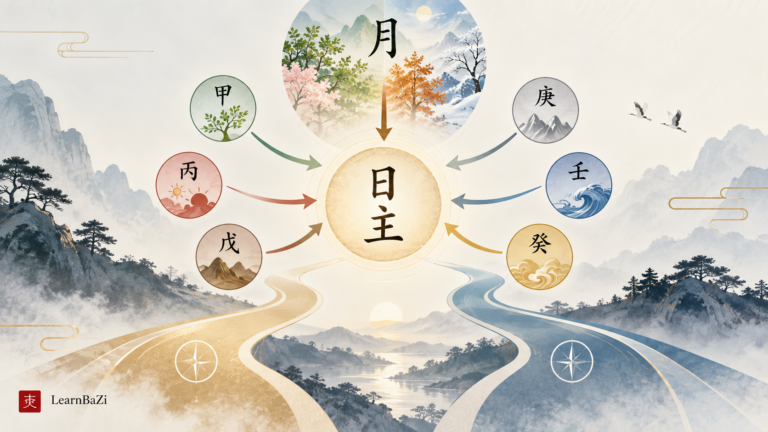
When studying BaZi, you may hear someone say that a Heavenly Stem is “rooted.” It sounds straightforward, but rooting is one of those concepts that can easily become confused with strength or general support.
A rooted Stem has an underlying connection to the Earthly Branches in the chart. That connection matters because it tells us something about how firmly the element is established, but rooting alone does not determine the final condition of the Stem.
What Does Rooted Mean in BaZi?
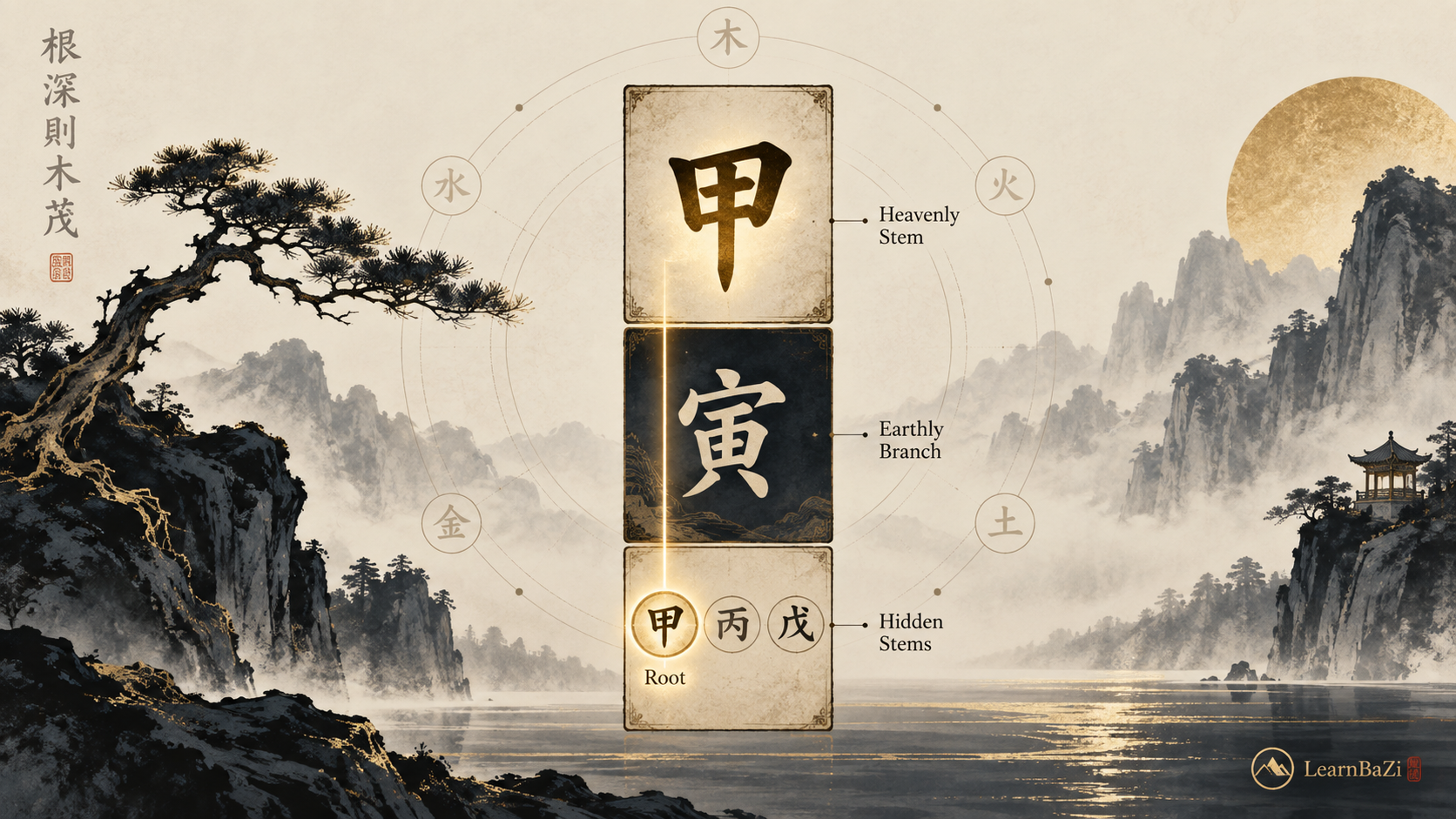
A Heavenly Stem is generally considered rooted when the same element is present within one or more of the Earthly Branches. This presence may be found through the hidden stems contained within those branches.
For example, if 甲 Jiǎ Wood appears as a Heavenly Stem and Wood is also present within a branch such as 寅 Yín or 卯 Mǎo, we can begin examining whether that Heavenly Stem has a root.
The important idea is simple: the element is not appearing only at the visible Stem level. It also has a corresponding presence within the underlying branch structure of the chart.
A Simple Example
Suppose the Day Master is 甲 Jiǎ Wood. If Wood is present within one or more of the Earthly Branches, that gives us evidence that the Day Master is rooted.
This is useful information because a rooted Day Master has a different foundation from one that appears without corresponding Wood in the branches.
However, we should not immediately conclude that the Day Master must therefore be Strong. Rooting is an important part of the picture, but the wider chart still has to be considered.
Rooting Is Not the Same as Resource Support
This distinction is especially important. An element can support the Day Master without being its root.
If the Day Master is Wood, Water generates Wood and therefore functions as Resource. Water can support the Wood Day Master, but Water is still Water. It does not become a Wood root simply because it supports Wood.
Wood within the branches may provide rooting, while Water may provide Resource support. Both can matter when we assess the chart, but they describe different relationships.
Why Does Rooting Matter?
Rooting helps us understand whether a visible Heavenly Stem has an underlying elemental foundation within the chart. This becomes especially relevant when the Stem being examined is the Day Master.
When assessing the Day Master, we want to understand more than whether the element appears visibly. We also want to know whether it has support beneath the surface of the chart and how that support relates to the broader environment.
This is why hidden stems become more meaningful once you understand rooting. They are not simply another table to memorise; they help reveal the elemental structure contained within the Earthly Branches.
Rooted Does Not Automatically Mean Strong
This is probably the most common misunderstanding. A student finds one root and immediately classifies the Day Master as Strong.
But Day Master strength depends on more than rooting. Season, other supporting influences, weakening influences and important relationships within the chart also affect the eventual assessment.
A root therefore contributes information, but it should not be used as a shortcut to the final Strong or Weak classification.
Not Every Root Carries the Same Weight
Once you understand the basic definition, the next question is usually whether every root contributes equally. The answer is not necessarily.
The branch involved, seasonal environment, position and surrounding relationships can all affect how significant a root becomes. Different BaZi schools may also differ in how they evaluate particular roots.
For a beginner, it is enough to recognise that identifying a root is only the first stage. Learning how much weight to give that root belongs to the deeper process of Day Master strength analysis.
Three Common Mistakes About Rooting
The first mistake is assuming that rooted automatically means Strong. Rooting helps us understand the Day Master’s foundation, but the final strength assessment requires additional evidence.
The second mistake is treating Resource support as a root. Resource may support the Day Master, but rooting refers specifically to the presence of the same elemental family within the branches.
The third mistake is assuming that more roots automatically mean a stronger Day Master. The quality and context of those roots matter, not simply the number that can be counted.
Rooting Is Useful Beyond the Day Master
Although rooting is especially important when learning Day Master strength, the same concept can also be applied to other Heavenly Stems in the chart.
A visible element with meaningful roots may be established differently from an element that appears without much foundation below. This becomes increasingly useful later when studying Ten Gods and more advanced chart relationships.
For now, the key is to understand the concept correctly before trying to interpret everything it might mean.
Where Rooting Fits into Day Master Strength
When assessing whether a Day Master is Strong or Weak, rooting is one of several factors that need to be considered together. It tells us something specific about foundation, but it does not answer the entire strength question.
This is where BaZi becomes more interesting. Season, roots, support and weakening influences may point in the same direction, or they may compete with one another.
The real skill lies in knowing how to bring that evidence together and decide which influences carry the greatest significance. That requires a more systematic method than simply checking whether one root exists.
A Useful Way to Remember Rooting
When you see a Heavenly Stem, ask whether the same element also has a meaningful presence within the Earthly Branches. If it does, you have identified an important structural relationship.
Then stop before jumping to the final conclusion. The next question is not simply whether the Stem is rooted, but how that root fits into the wider chart.
That distinction will become increasingly important as you move from identifying BaZi components to actually analysing how they work together.
Continue Learning
If you are learning how to assess whether a Day Master is Strong or Weak, rooting is only one part of the process. The Strength of Day Master Specialist Course goes deeper into how roots, season, support, weakening influences and other relationships are evaluated together.
If you are still building your overall BaZi foundation, begin with BaZi Master Class — Level 1. It places concepts such as Heavenly Stems, Earthly Branches, hidden stems and Day Master strength within the wider chart-reading framework.
The goal at this stage is not to memorise every exception. Understand what rooting tells you, recognise what it does not tell you, and then build the deeper assessment from there.