Why do certain patterns seem to repeat in our lives? Why do some periods feel relatively smooth, while others seem to demand much more effort? And why might one person thrive in a particular environment while another struggles in the same situation?
Questions like these are often what bring people to BaZi. Some are looking for greater self-understanding, while others are curious about timing, relationships, career or simply the traditional Chinese way of looking at life patterns.
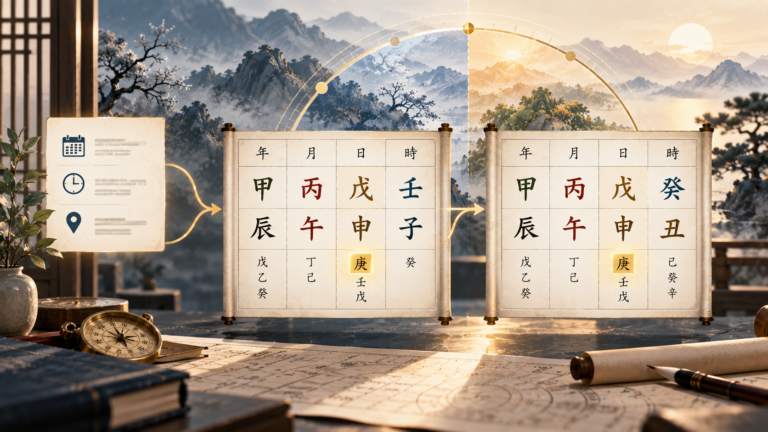
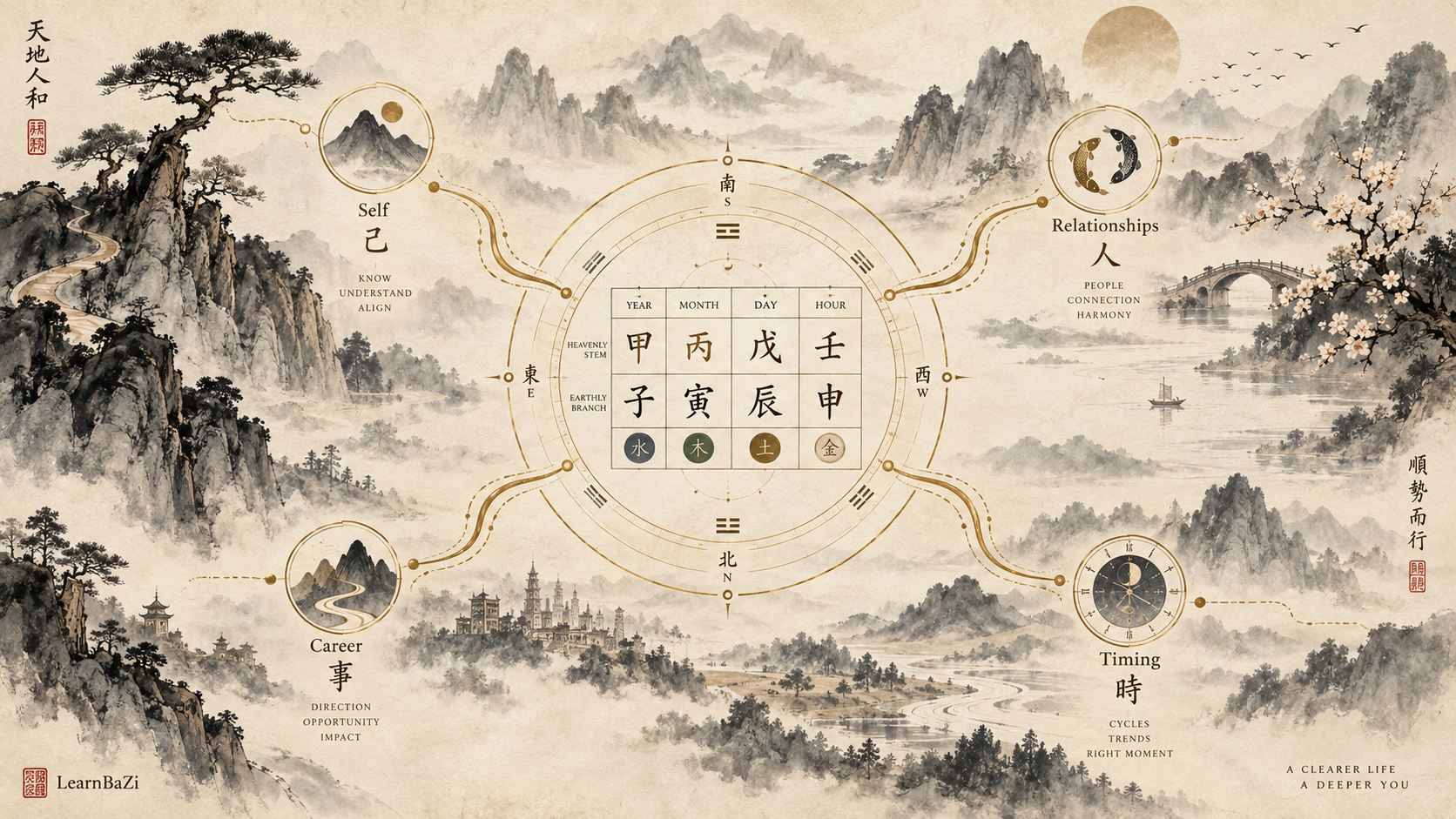
BaZi, or 八字 Bā Zì, is a traditional Chinese system of destiny analysis. It studies a person’s birth information through the Four Pillars of Year, Month, Day and Hour, then examines the relationships between the Heavenly Stems, Earthly Branches, Five Elements and different layers of time.
At first, this can sound rather technical. Yet the purpose of BaZi isn’t simply to predict what will happen next. Its real value lies in helping us recognise patterns, understand changing conditions and ask better questions about the situations we face.
What Is BaZi Destiny Analysis?
A BaZi natal chart contains four pillars: the Year Pillar, Month Pillar, Day Pillar and Hour Pillar. Each pillar contains one Heavenly Stem and one Earthly Branch, giving us the Eight Characters from which BaZi gets its name.
Generating those eight characters is only the beginning. A practitioner may go on to examine the Day Master, Five Elements, Ten Gods, roots, combinations, clashes and other relationships within the chart.
Timing can then be added through Luck Pillars, annual pillars and other changing influences. These help us study how the natal chart interacts with different periods of life.
This is why BaZi is much more than identifying a Chinese zodiac animal or counting how many Wood, Fire, Earth, Metal or Water elements appear. It is fundamentally a system of relationships.
Why Do People Study BaZi?
People come to BaZi for different reasons. Some want to understand themselves better, while others are interested in relationships, career, important decisions or periods of change.
Some simply enjoy Chinese metaphysics as an analytical subject. There is a certain satisfaction in learning how individual pieces gradually come together to form a larger picture.
At first, a chart may look like a collection of unfamiliar Chinese characters. Then you begin recognising the Five Elements, followed by the Ten Gods, roots and interactions between the pillars.
Over time, the chart starts to look less like eight separate characters and more like one connected structure. That is often when BaZi becomes much more interesting.
BaZi Can Help Us Recognise Patterns
One useful aspect of BaZi is that it gives us a structured language for examining tendencies and recurring themes. The Ten Gods, for example, describe different relationships between the Day Master and the other elements appearing in the chart.
Depending on the chart and context, these relationships may be associated with themes such as learning, expression, competition, wealth, responsibility, authority or support.
But they should not be turned into rigid personality labels. A person with prominent Output characteristics, for example, may express them through teaching, sales, writing, design, entrepreneurship or many other activities.
The underlying relationship may be similar while the real-life expression is completely different. This is one reason context matters so much in BaZi interpretation.
A BaZi Chart Does Not Describe the Whole Person
It is tempting to see one prominent chart feature and conclude, “This is the kind of person you are.” In practice, BaZi is rarely that simple.
A chart may describe tendencies, but people also develop through upbringing, education, culture, experience and circumstance. Two people can have similar chart structures and still live very different lives.
Their opportunities may differ. Their family environments may differ, and their choices can take them in completely different directions.
BaZi is therefore better treated as another layer of information rather than a complete definition of the person.
BaZi Also Studies Timing
A natal chart represents the underlying structure present at birth, but BaZi also recognises that conditions change over time. This is where 大运 Dà Yùn, or Luck Pillars, become important.
Annual and monthly pillars can add further timing layers. As new Heavenly Stems and Earthly Branches arrive, they interact with the natal chart and may make certain relationships more prominent.
A combination may form, a clash may become active or an existing theme may receive additional support. This is one reason different periods of life can feel very different even though the natal chart itself has not changed.
The underlying chart remains the same, but the conditions surrounding it continue to move.
Timing Does Not Mean Certainty
This is also where BaZi interpretation can become too absolute. Suppose a particular relationship becomes active during a certain year. It would be risky to conclude that one exact event must therefore happen.
A more careful interpretation is to say that the themes connected with that relationship may become more prominent during the period.
For example, stronger Authority influences could relate to responsibility, rules, pressure or accountability. For one person, that may coincide with a promotion. For another, it may involve stricter management, examinations or increased responsibilities elsewhere in life.
The symbolic relationship may be similar, but the real-world expression can be very different.
BaZi Is Better at Describing Conditions Than Guarantees
One useful way to think about BaZi is through a weather forecast. If tomorrow’s forecast shows heavy rain, that information can help you prepare.
You may carry an umbrella, change your route or postpone an outdoor activity. The forecast affects how you plan, but it does not decide what you must do.
BaZi can be approached in a similar way. It may help us understand the conditions surrounding a certain period and identify areas that deserve more attention.
We still decide how to respond.
What BaZi Cannot Tell You with Certainty
BaZi can be detailed, but there are limits to what any chart can responsibly establish. We should be cautious whenever an interpretation claims far more certainty than the chart itself can support.
I would be particularly careful with claims that BaZi can guarantee the exact career someone must choose, the subject a child must study, whether a particular investment will make money or whether one unavoidable event will occur.
The same applies to promises of guaranteed success or guaranteed failure. A BaZi chart provides an interpretive framework, but it does not remove uncertainty from life.
Nor does it replace professional knowledge, practical evidence or personal judgement.
What the Chart Shows and What We Infer
This is an important distinction in the LearnBaZi approach. There is a difference between what the chart shows, what the practitioner interprets from it and what the person eventually decides to do.
Suppose the chart contains a clash between two Earthly Branches. The existence of that clash can be observed directly.
What the clash means in the context of career, family, movement or relationships requires further interpretation. The person’s eventual response is another matter entirely.
The stronger the conclusion, the stronger the supporting chart evidence should be.
Can BaZi Help with Career and Important Decisions?
Yes, but not usually by revealing one predetermined answer hidden inside the chart. BaZi is often more useful for exploring broader tendencies, conditions and timing.
In a career discussion, for example, we might examine themes involving expression, responsibility, commercial activity, specialist knowledge, organisation or independence.
Those observations can help frame the discussion, but they still need to be compared with the person’s actual skills, opportunities, responsibilities and preferences.
The same principle applies to business, relationships and other important decisions. BaZi can contribute another perspective without replacing practical judgement.
What About Children and Education?
Parents sometimes look at a child’s BaZi chart to understand temperament, learning tendencies or areas of natural comfort. Used carefully, this can encourage better observation.
A chart may suggest that we pay attention to how a child responds to structure, pressure, competition or different learning environments.
But those observations should not become fixed labels. Saying that a child is unsuited to a subject or career simply because of a BaZi chart goes far beyond what the chart can responsibly establish.
BaZi should help us observe a child more carefully, not decide the child’s future in advance.
Destiny Does Not Mean No Choice
The word “destiny” can make BaZi sound more deterministic than it needs to be. A difficult Luck Pillar does not mean there is nothing we can do, just as a favourable Luck Pillar does not guarantee that everything will work out automatically.
Conditions matter. Timing matters. Preparation and action matter too.
A useful way to think about BaZi is through six ideas: tendencies, conditions, opportunities, challenges, timing and choices.
The chart helps us study how these factors may relate to one another. The person still lives the life and makes the decisions.
A Practical Way to Think About BaZi
At LearnBaZi, I prefer to keep one simple distinction in mind: first observe what is present in the chart, then interpret what those relationships may mean within the relevant context.
After that, compare the interpretation with reality. Does the available evidence support the reading, or are we trying to force the chart to fit an assumption?
The final decision still belongs to the person. BaZi may inform the process, but it does not take responsibility for the outcome.
This approach becomes increasingly important as you move from basic concepts into deeper chart interpretation and timing.
The Questions Become Better
When people first discover BaZi, they often want to know what will happen to them. That is understandable because prediction is one of the things that attracts people to destiny analysis.
As you become more familiar with the system, however, the questions usually become more useful. Instead of only asking what will happen, you begin asking what patterns are present, what is changing and which themes deserve more attention.
You may also begin asking what options are available and what you can do differently.
That shift is important. BaZi becomes less about waiting for a prediction and more about understanding conditions and possibilities.
So Why Study BaZi?
BaZi gives us a structured way to study patterns, relationships and timing through the traditional language of Chinese metaphysics.
It can help us organise complex information, examine changing conditions and look at familiar situations from another perspective.
For those who enjoy Chinese metaphysics, it is also a deep analytical subject that can take many years to master. There is always another layer to understand once the foundations become familiar.
BaZi does not need to guarantee every future event in order to be useful. Careful interpretation is often more valuable than dramatic certainty.
Continue Learning
If you are new to BaZi, begin with the LearnBaZi Learning Path and build your foundation progressively.
Once you are familiar with the Four Pillars, Five Elements, Day Master and basic relationships, continue with Is There a Best Way to Read a BaZi Chart? to understand why different schools may approach the same chart differently.
You can then move to A Systematic Method for Reading a BaZi Chart for an overview of how the different parts of a reading can be organised.
The objective is not to memorise everything at once. Build the foundations, understand the relationships and let deeper interpretation develop from there.